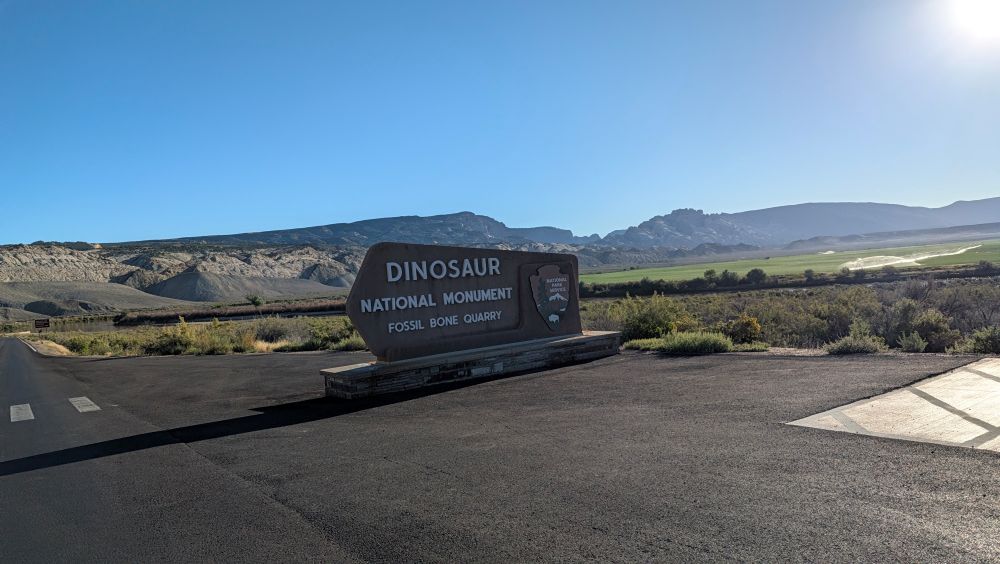
When most people think of Dinosaur National Monument, they picture either sweeping canyon vistas or a quick stop at a visitor center. But devoting a full day to the Utah Side of Dinosaur National Monument near Vernal gives you the best of both worlds: world-class paleontology, thousands of years of human history, and short, rewarding canyon hikes.
Day two of the trip, and we were already dinosaur-brained. Day one had been travel and museums — including a stop at the Utah Field House of Natural History, which turned out to be the right call, because by the time we got to the real thing the next morning, we actually knew what we were looking at.
I wanted an early start, we get up early anyway — but I think there was a little of we don’t need to get there as soon as they open type of energy in the car. But it was Labor Day weekend and I did not want to share the fossil wall with a bunch of kids yelling or being in my photos. So we got to the Quarry Visitor Center right at 8:15 AM, and it turned out to be worth every bit of the early alarm.
The Wall of Bones
Coffee doesn’t get to come with you past the visitor center — no cups on the shuttle, none in the exhibit hall — so Justin left his in the car, a small sacrifice for science. Stepping off the shuttle, I remember being surprised the exhibit hall was an actual building; somehow I’d pictured this more exposed. Turned out to be a relief, since the desert was already starting to warm up.
Being some of the first people in, the place was quiet — quiet enough that when I dropped my phone (brand new, of course), the sound cracked and echoed through the whole hall. But that embarrassment lasted about half a second, because right in front of us was the wall.
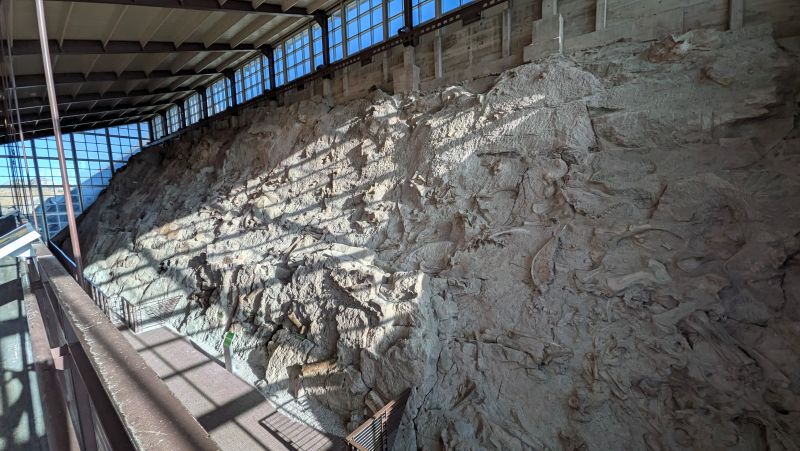
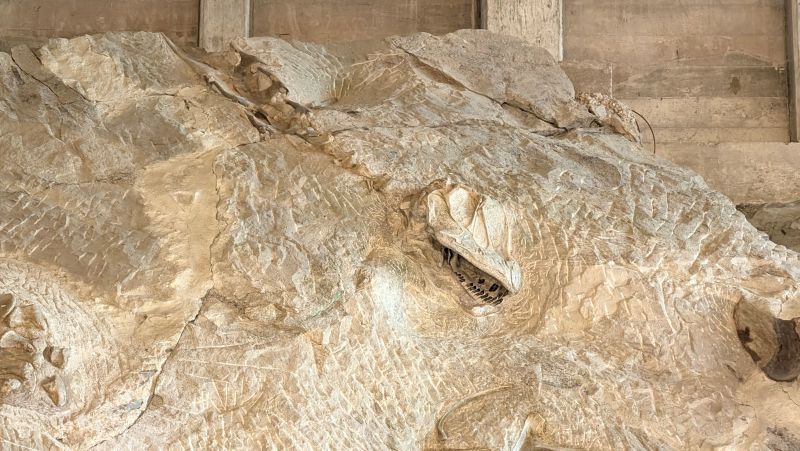
It’s hard to describe what it’s like to actually stand in front of it. The Quarry Exhibit Hall is built directly over the original Carnegie Quarry dig site, and the rock face still holds more than 1,500 fossilized dinosaur bones exactly where an ancient river left them roughly 150 million years ago — full spine segments, huge leg bones, skulls, all still emerging from the stone.
After a few minutes, Justin found the little brochure stand and we paid our dollar for the guide — and having spent the dollar, we suddenly felt obligated to actually use it, so we ended up taking our time and reading every panel instead of doing a quick lap. Afterall, this is why we came here. For this spot.
Standing on the two-story viewing platform allows you to trace full sauropod spine segments, massive leg bones, and distinct Allosaurus and Camarasaurus skulls protruding directly from the rock face. We both just stopped talking and stared at it for a while. We were in the exhibit hall for almost an hour soaking it in. We were close to the door on the bottom level with just a few more things to look at when a family comes in and one kid is crying another started to run and since it is so open it all echos — and I look over to Justin and my eyes said it all ‘see, this is why we got here at 8:15. It’s time to go. Wrap up.’
It all started with one man scrambling over this same rock in August 1909. Earl Douglass, a paleontologist sent out from the Carnegie Museum, had spent weeks finding nothing and was ready to give up — until he spotted eight tail vertebrae from an Apatosaurus poking out of the sandstone. He later wrote it was “a beautiful sight.” That one find turned into 350 tons of fossils and, six years later, a national monument.
Down the Fossil Discovery Trail
Rather than ride the shuttle back down, we walked the Fossil Discovery Trail — 1.2 miles that drop you straight through the geologic timeline. A short spur off the main trail gets you close to raw, unexcavated bone still stuck in the cliff. Lower down, the rock changes completely: ancient seabed, with tiny fossilized clams and squid-like belemnites from back when this whole area was under a shallow ocean. Strange to think about, standing in the middle of the high desert.
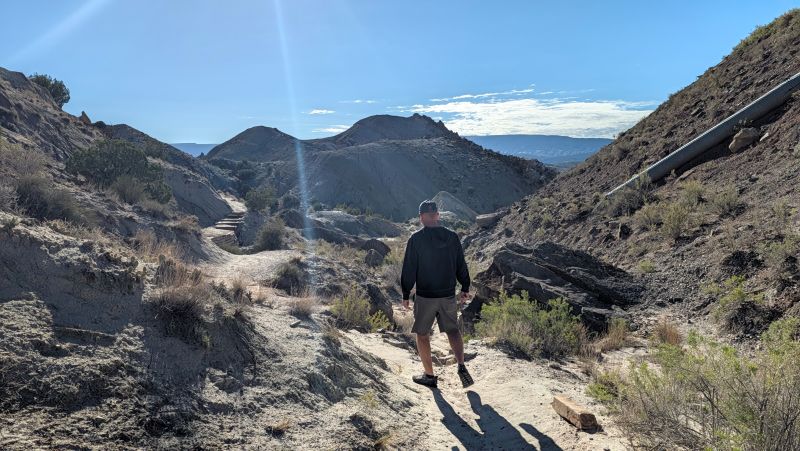
Cub Creek Road: View the drive from the Quarry to Josie Morris Cabin within the Utah Side of Dinosaur National Monument
Back at the car, we picked up Cub Creek Road — the “Tour of the Tilted Rocks” — a 12-mile drive that follows the Green River past cottonwoods, open desert, and rock layers tilted up at odd angles. The road is a mix of paved and dirt sections. We drove straight through so we can record, then stopped at on our way out. Watch the video below.
Three Bighorn Sheep and a Change of Plans
We’d planned to hike toward Josie Morris’s cabin next, but three bighorn sheep had other ideas — full-grown, calmly parked right along the path like they owned it, which, fair, they kind of do.
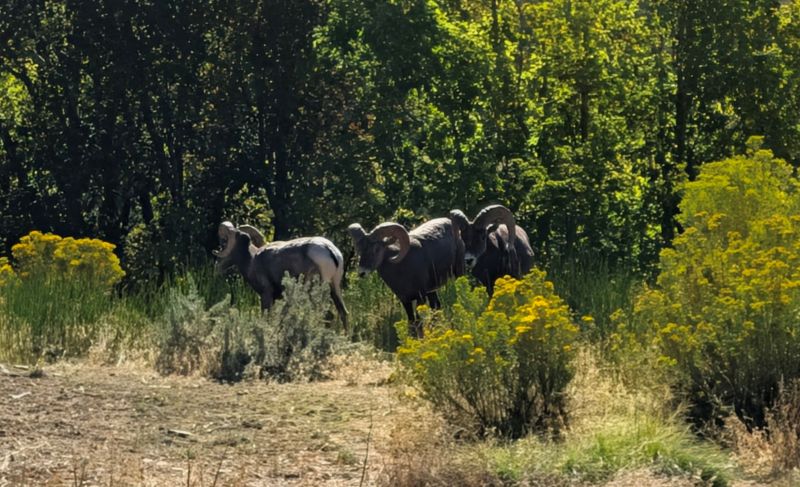
This is where Justin and I revealed two very different relationships with wildlife. He kept inching closer to get a better look. I kept inching the opposite direction, muttering “Justin, back up” to absolutely no effect, until I gave up and went to watch from across the little pond instead. Another group came up while we were debating what to do, and I gave them the heads-up about the sheep — no idea if they waited them out or pushed past, but we gave it five or eight minutes before deciding the trail could wait, we’d do the other one first.
Josie Morris Cabin
On our way out of the trail we figured we’d look at Josie’s cabin since we were right there. The historic homestead of Josie Morris, a legendary local figure who built a home here in 1913 and lived there alone wihtout electrisity or running water, well into her eighties. She was married five times, twice accused (never convicted) of cattle rustling, and by most accounts knew Butch Cassidy personally. Not exactly the “quiet pioneer woman” image the peaceful little cabin suggests.
Woops, it looks like I forgot to take a picture of this.
Box Canyon
I don’t fully know why large animals at close range spook me the way they do. But it must be contagious, because soon after the sheep, we noticed the bear warning sign posted on the trail entrance to Box Canyon — and suddenly I was thinking about animals a lot more than I had been ten minutes earlier. It was OK, I just walked heavy, talked with Justin, and every once in a while said “heellllloooooo bbeeaarr”
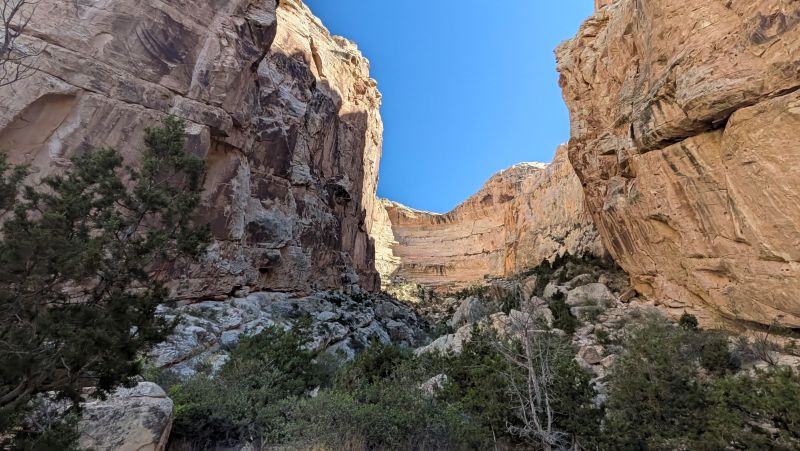
With the cabin trail blocked, we pivoted to Box Canyon instead — and it turned out to be the right call regardless. The trail slips into a narrow, vertical-walled slot canyon that Josie herself once used as a natural corral, and after a morning in full sun, it was a relief: shade trees, a sandy floor, an actual breeze moving through the walls. Short, easy, and honestly one of the more relaxing stretches of the whole day.
Petroglyphs
This stretch is where the Fremont petroglyphs start showing up — carved into the dark “desert varnish” coating the sandstone roughly 1,000 years ago. We stopped at Swelter Shelter first, with some of the oldest painted and carved figures in the park, then at the main panels further down, where broad-shouldered human figures wear elaborate headdresses and necklaces.
Then came the lizard hike. We couldn’t see them from our binoculars from the parking lot, and we saw people up above. They looked so high above, that I was like, shoot, are we going up there? We figured we were here — we had to do it. So we started walking and another family came down and I asked them and they said it was worth it, and it was shorter than it looked. So we carried on. And I was glad we did. It wasn’t nearly as bad as it looked from the bottom, and up close you get a real sense of scale on the carvings that you just don’t get from the road. The view from the top wasn’t bad either. We both lost our footing once on the gravel on the way down and slid a little — nothing dramatic, just enough to remind us to slow down.
Once we got back to the parking lot, seeing the lizards without binoculars was no problem — we just weren’t looking in the right spot before.
Deciding We Weren’t Done
By 1 PM we’d seen the wall of bones, done three hikes and the full scenic drive on Cub Creek Drive — about five hours in the park — and we were, undeniably, still in dinosaur mode, wanting more. I’d gone back and forth beforehand on whether the half-day would end with McConkie Ranch or a trip out to Red Fleet State Park to see actual dinosaur tracks. In the moment, though, it wasn’t really a debate. We were already thinking in dinosaurs. Red Fleet won, and McConkie Ranch got bumped to the next day. (Read about the Red Fleet dinosaur tracks here.) It fit the day perfectly, even if it didn’t do our overall road-trip pacing any favors.
Overall thoughts about the Utah Side of Dinosaur National Monument
We really enjoyed the the Utah Side of Dinosaur National Monument. We love history and seeing so many dinosuar bones at the Quarry Exhbit Hall was just amazing. We were glad we went to the Utah Field House of Natural History State Park Musuem the day before so we had an idea about the types of dinosaurs and rocks within the park. It just all tied together nicely.
But, the name of the monument is a little misleading — Dinosaur in its name, you’d think there would be a lot more than what is in the Quarry area. But there isn’t. I knew this going in, so I wasn’t let down. The rest of the park is scenic and has history, and worth the half day spent on the Utah side, but I can also see people in a rush just coming for the Quarry Exhibit Hall. And the other 2 parts of the park have no dinosaur connection.
The Petroglyph’s are always ‘fun’ to see. And the ones in the park ended up being a warm up for more we’d see the next day.
Other posts from this trip:
- 4-Day Dinosaur National Monument Road Trip Itinerary
- Exploring the North Side of Dinosaur National Monument: Gates of Lodore & Ancient River Canyons Worth the Long Drive
- 2 Hours Driving the Colorado Side of Dinosaur National Monument: Harpers Corner Scenic Drive & River Canyons
- Beyond the Monument: Rock Art, Trackways, and Small-Town Treasures Around Vernal, UT


