By day four, Justin and I had a system. Three of our four days on this trip had already put us over five hours in the car — and that was before we added the Colorado side of Dinosaur National Monument to a day that was supposed to just be the drive home. We’d flirted with this same math over the summer, too, on a Denver-to-Dodge-City run that taught us both what “one more stop” really costs on a road trip. We should have known better. We did it anyway.
The plan had actually lived on day three originally — but somewhere in the middle of day two, standing on the Utah side listening to a ranger explain, in more detail than I wanted, exactly why we would not be driving down to the floor of Echo Park, we scrapped it. That’s the day we decided to chase the Gates of Lodore instead (link to that post), and pushed Harpers Corner Scenic Drive to the very last morning, wedged between checkout and a six-hour trip back to Denver.
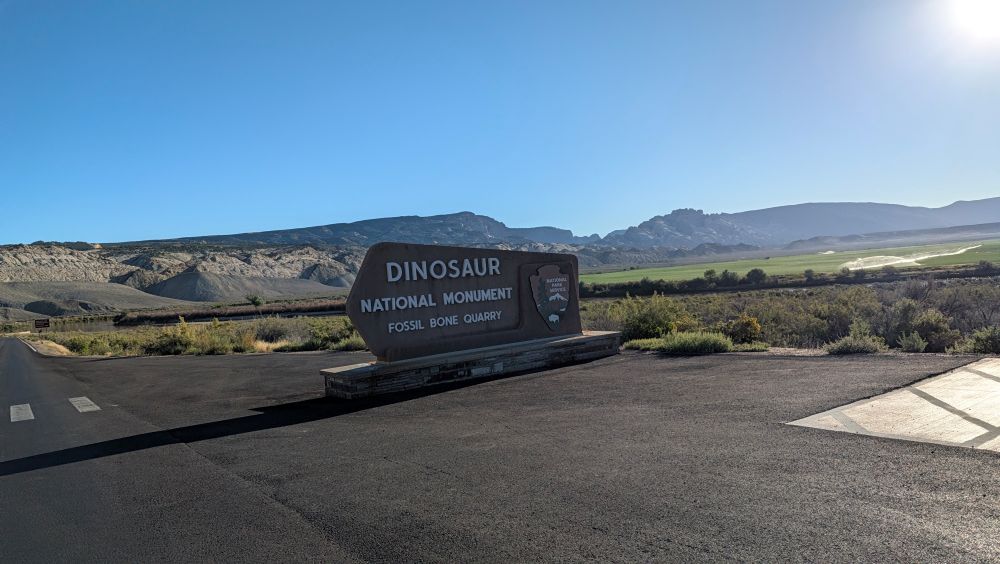
We got to the park entrance at 8:15 AM, 45 minutes from when we left the hotel.
Cows, Not Traffic
Vernal had more cars on the road than we expected as we left town, a clear indication the holiday weekend was over — which, in its own small way, was the trip’s first “we should go home” nudge before we’d even started. But we hadn’t come all this way to half-see the place. So we drove in anyway, telling ourselves we’d get a good chunk of it in, even on a tight morning.
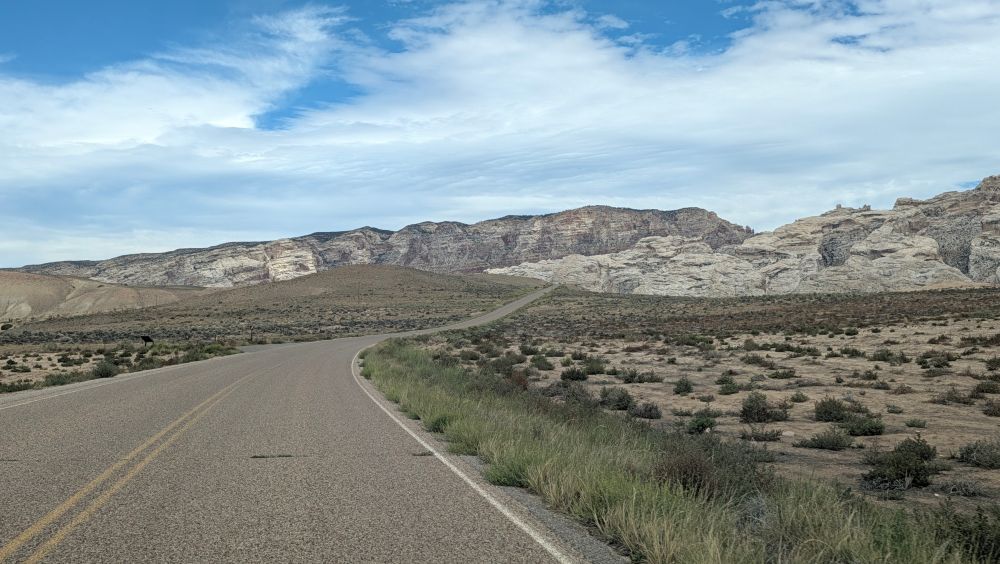
The road inside the monument had the opposite problem: barely any traffic at all, just us and whatever wildlife happened to be up early too. Cows ambled near the shoulder, deer moved through the sage, birds flying or eating the brush — the kind of low-key wildlife parade you only get if you’re out before the day heats up. No podcasts, no audiobook for this stretch. That was for the highway later. In the park, it was just the two of us, the windows down, actually talking.
Harpers Corner Road
Harpers Corner Scenic Drive doesn’t behave like the Utah side of the monument. There, you’re down in red rock, close enough to touch the fossils and petroglyphs. Here, the road runs 31 miles on a paved road and you’re up above everything — wide plateau country falling away on both sides, distant mountains doing their thing on the horizon. It’s a quieter kind of dramatic. Slower, too: the whole drive took about an hour each way, at a pace that made our six-hour deadline start to feel very real, very fast.
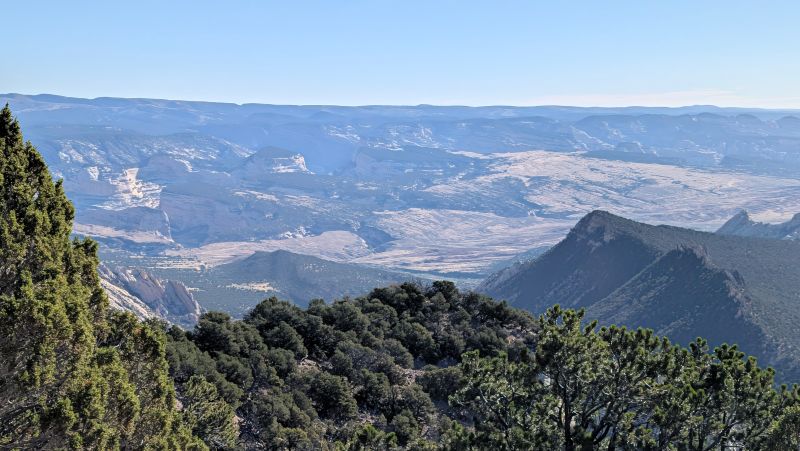
Scenic Drive of Harper’s Road on the Colorado Side of Dinosaur National Monument
Echo Park, From a Distance
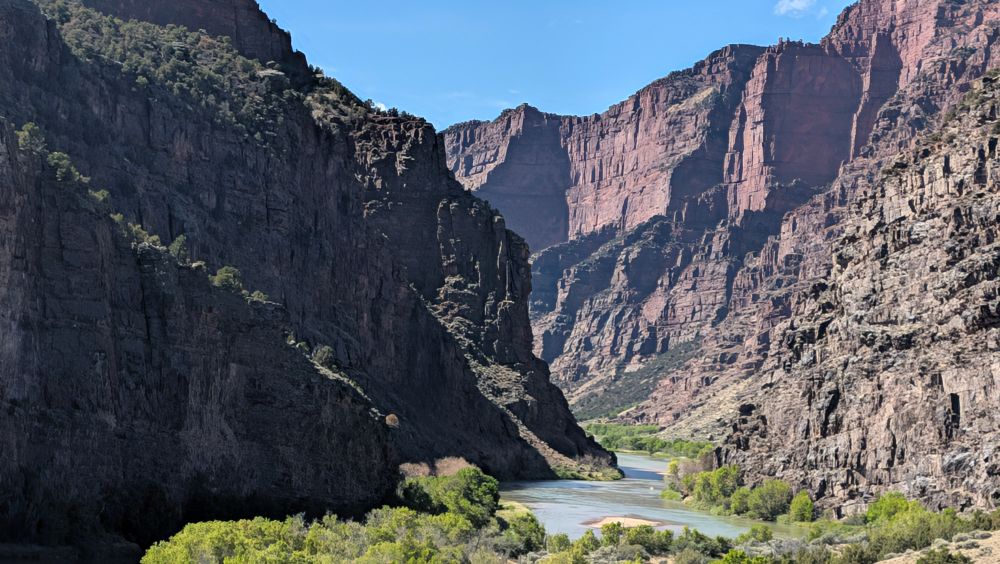
Echo Park Overlook is the one stop on this drive that actually delivers the sheer, straight-down canyon views you picture when someone says “Dinosaur National Monument.” From up top, you’re looking into the spot where the Yampa River, running muddy and brown from its 250-mile trip east, meets the clear green water of the Green River — and the two rivers curl together around Steamboat Rock, a slab of sandstone that’s been standing there since long before it had that name. Early explorer John Wesley Powell called it Echo Rock in 1875; “Steamboat” didn’t show up on a map until 1941.
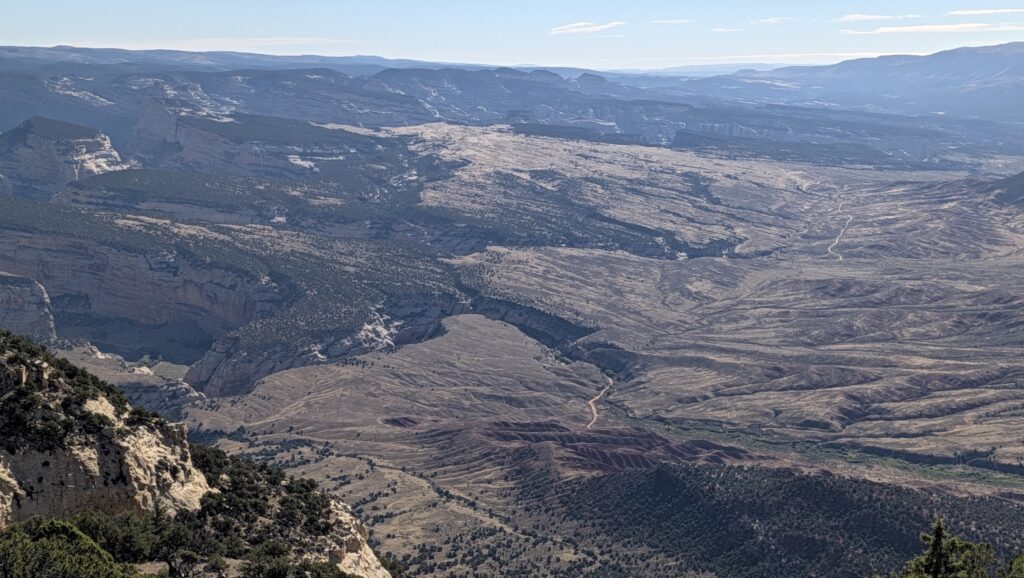
We’d hoped to get down there. That’s actually part of why we brought the Subaru instead of the sedan on this trip — a little insurance for exactly this kind of unpaved, high-clearance road. But Echo Park Road had taken on rain earlier in the trip, and between that and what the ranger told us on day two, we made peace with viewing it from above. Standing at the rail, watching that thin ribbon of road switchback down into the canyon, I did mentally start pricing out a Jeep – we’d have a lot more fun adventures if we can get off road a little more!
Small thing I didn’t know until this trip: dams almost erased this exact view. In the late 1930s, the Bureau of Reclamation surveyed Echo Park as a site for a hydroelectric dam that would have buried Steamboat Rock under 500 feet of reservoir. It didn’t happen — but it came close enough that the fight to stop it became one of the founding stories of the modern conservation movement.
Turning Around
The drive ends at the Harpers Corner trailhead, where a short trail leads out to a narrow finger of land overlooking the Green River’s big bend through Whirlpool Canyon. We got to the end of the road around 9:15 AM thinking we’d do the hike, but we did the math with the signage said 1-2 hours for the hike, and wanting to be home by 4. So we agreed to skip the hike and turn the car around for our trip home.
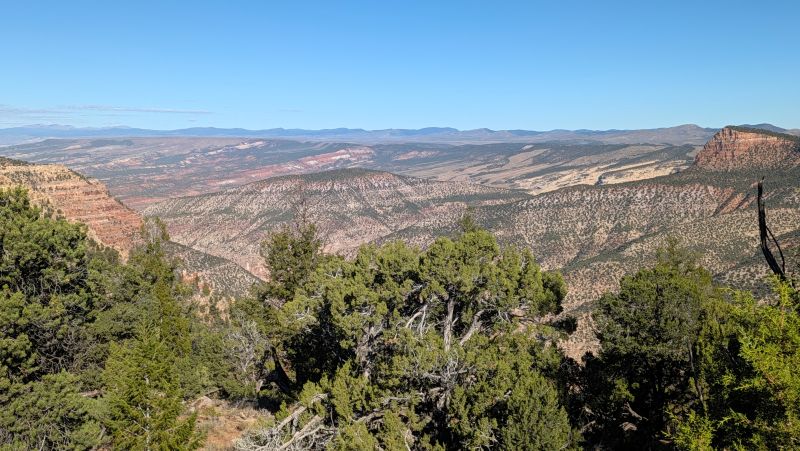
I regret it a little, honestly. All that driving — an hour out, an hour back — for views that were good but distant, when maybe another fifteen or twenty minutes of walking would have put us at the edge of something a little better. Would a little bit of a walk given us a better view? Or would we have had to the the whole thing? That’s the frustrating shape of this particular stop: the great part is at the end of the park — and well, we just ran out of time.
Three Canyons
Here’s the thing this whole detour left me thinking about: I don’t think most people picture canyons when they picture Colorado. Mountains, sure. Ski towns, fourteeners, aspens turning gold — that’s the postcard. But I now personally know of at least three serious canyons in this state: this one, cut by the Green and Yampa, the Black Canyon of the Gunnison, which somehow drops even deeper — over 2,700 feet at its most dramatic point, so narrow and steep that sunlight barely reaches the river at the bottom, and the Royal Gorge near Cañon City. Different rock, different rivers, same basic fact: Colorado has been quietly hiding some serious gorges behind its mountain reputation.
The Long Way Home
Leaving the Colorado Side of Dinosaur National Monument entrance, it was the drive we’d actually planned for — coffee in one of the small towns on the way out, takeout lunch in Steamboat Springs, and, because we wanted to stop here last month, a 3 PM beer at Cabin Creek Brewing, right off I-70 by the lake in Georgetown.
As we drove, we found ourselves debating: was the Colorado side of Dinosaur National Monument actually worth the detour? I’m honestly torn. I’m the type of traveler who likes to see every last corner of a park, and I never mind a long drive—especially if it’s scenic. But while this route was pleasant enough, it felt like a lot of miles for a view that was ultimately just okay.
Maybe I’ve gotten a bit spoiled by past travels, but it simply wasn’t jaw-dropping. If you pair the drive with Echo Park Road, it might be a different story with far more dramatic scenery. What made it tougher for us was the context: it was our final drive home, and because it’s an out-and-back route, that last hour felt especially long when we were rewatching the same landscape.
We took turns driving. Justin drove us into the park that morning; I took over for the next two and a half hours, then he drove another four, and I got us the rest of the way home. The drive out of the mountains was easy, normal, the kind of driving that lulls you. Then we hit Denver, and it turned into a parking lot — 75 extra minutes we didn’t want to be in the car for.
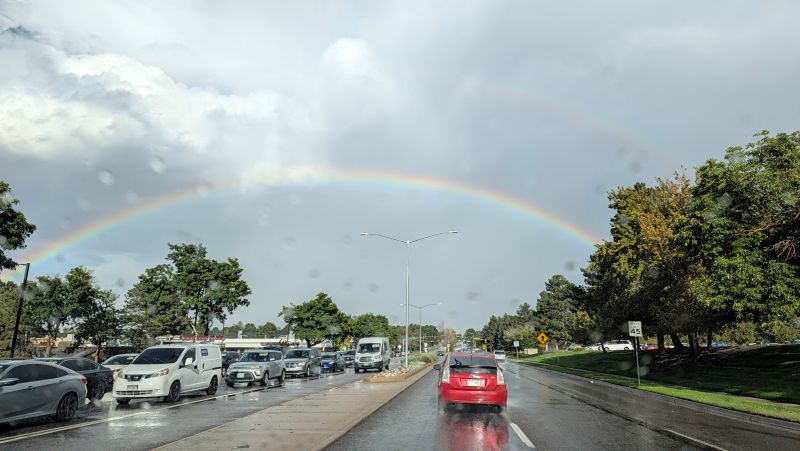
Just as we were a few blocks from our street, at 5:15 PM, there was a full double rainbow stretched over the sky. It’s a small thing. But after that kind of day, it did exactly what it needed to do — knocked the traffic-grump out of both of us and replaced it with something closer to gratitude. Sometimes the trip isn’t done teaching you things until the very last minute you’re in the car.
By the time I got home, my right leg was aching — all that sitting and driving, probably. My leg hurt for over a week. A good reminder that a long road trip is a lot like a long flight: you need to get out and stretch your legs every once in a while.
More posts from this trip:
- 4-Day Dinosaur National Monument Road Trip Itinerary
- Exploring the Utah Side of Dinosaur National Monument: Fossils, Rock Art, and Canyon Hikes
- Exploring the North Side of Dinosaur National Monument: Gates of Lodore & Ancient River Canyons Worth the Long Drive
- Beyond the Monument: Rock Art, Trackways, and Small-Town Treasures Around Vernal, UT