My birthday was coming up, and instead of the usual dinner-and-cake routine, I started thinking: is there something different we could do? Something that’s been sitting on my Colorado bucket list forever, just waiting for an excuse?
I honestly don’t even remember how I landed on the answer. I think I was digging back through an old blog post about Florissant Fossil Beds National Monument for something unrelated, and the Florissant Fossil Quarry popped up in my search results. Either way, once I saw it, I knew that was the plan: two hours from home, a full day of adventure, and the chance to actually dig up something that existed 34 million years ago. Sold.
The Morning Didn’t Go According to Plan
We set out around 7 a.m., figuring we’d swing by the national monument first since it’s basically right down the road from the quarry. But first, coffee. And apparently the lid on Justin’s cup wasn’t snapped on all the way, because it ended up all over him before we’d even really left town. Cue an unplanned detour to his mom’s house to clean up, which put us about 40 minutes behind schedule.
At that point we made an executive decision: the quarry was the non-negotiable part of the day, so we’d head straight there and see about the monument afterward if we had time and energy left.
Arriving at the Florissant Fossil Quarry
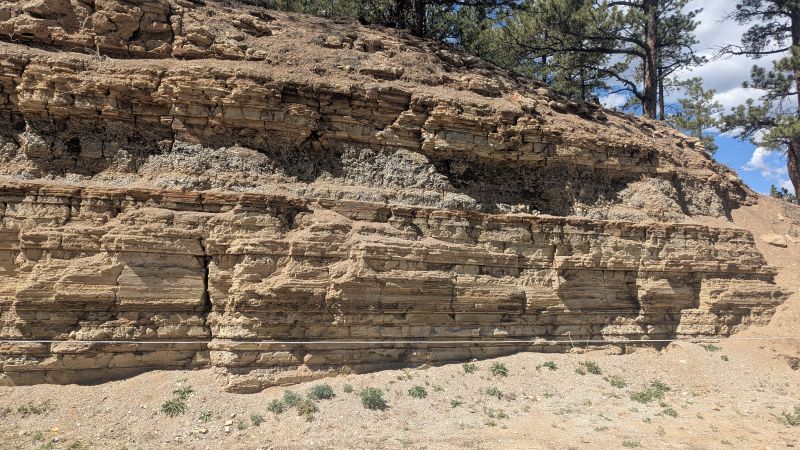
We were greeted by a wonderfully patient older woman (the Florissant Fossil Quarry has been run for years by Toni Clare and Nancy Clare Anderson) who walked us through how to use the splitting tools, what we were looking for, and how the layers of shale tend to want to separate. She set us up with a bin of material that had already been pulled from the ground, so we could start there, and told us we were also welcome to poke through the spoil piles nearby if we wanted to try our luck on fresh material.
The pitch is simple and confidently made: they guarantee everyone finds something. Pricing is straightforward too — $20 per person, per hour, cash only, no reservation needed unless you’re a group of 10 or more.
Digging In
We sat down at a picnic table, knife and chisel in hand, hoping for something dramatic — a perfect leaf, a delicate insect, or (my personal dream) one of those coiled ammonite-looking things you see behind glass at natural history museums. Turns out that last one was wishful thinking; Florissant is a lakebed deposit, not a marine one, so what you’re actually hunting for is fossilized leaves, seeds, insects, and the occasional fish or feather — not ammonites. Nobody told me this beforehand (maybe I should have realized it, but since we were recently in Kansas where there was an ocean, I forgot about lakes), but hey, now you know.
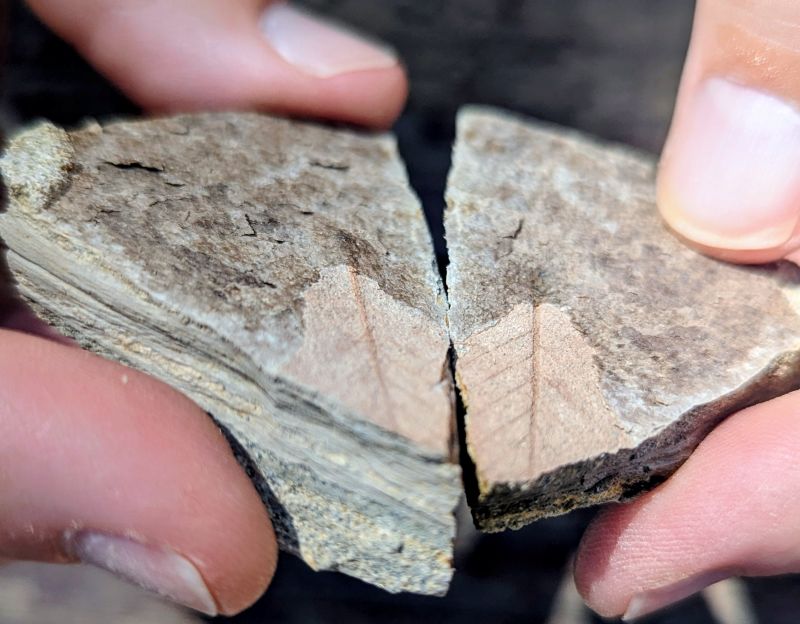
Justin found his first fossil within about three minutes. One of the neat things about splitting shale this way is that when a piece opens up cleanly, you often get what’s called a part and counterpart — the fossil splits into two matching halves, each showing a mirror image of the other. You can literally hold both pieces side by side and watch the same leaf veins line up across the crack. It’s a small detail, but it made the whole process feel a little less like just breaking rocks.
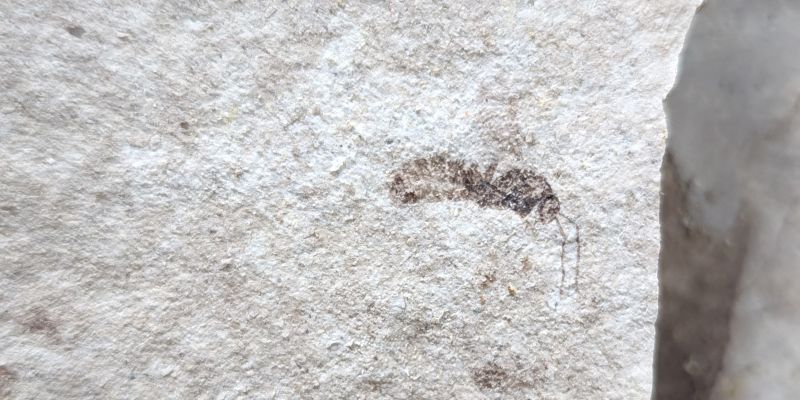
I was not nearly as lucky — it took me a solid 30 minutes before I finally uncovered a small fossilized bug.
The hour went by fast, and honestly, once I hit that 30-minute mark without much to show for it, I noticed a little “achievement anxiety” creeping in. I hope I find something. I really don’t want to pay for a second hour. It’s a strange thing to admit, but that low hum of pressure took a little bit of the relaxed fun out of it for me.
By the end of our hour, between the two of us we’d found: 2 bugs, 2–3 different types of leaves (with a few repeats), 2 other fossilized somethings we honestly couldn’t identify,
Not bad for a couple of first-timers.
And it was exciting to hear what other fossil hunters at other tables were finding — the kids were the best, their joy matching my excitment.
What We Actually Found
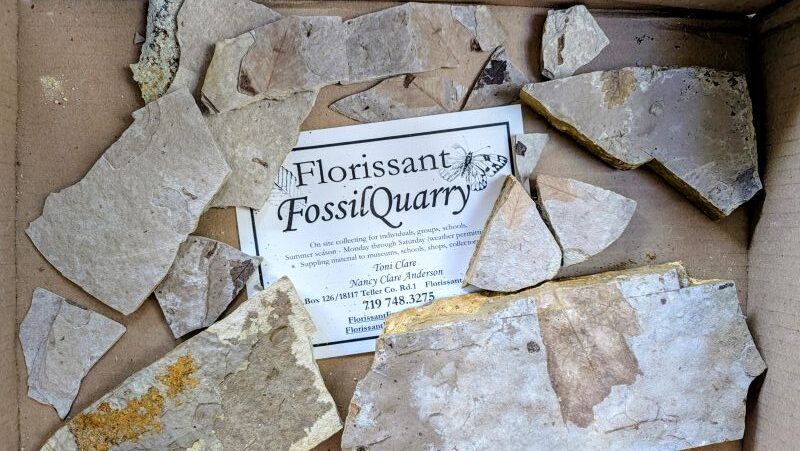
I tried to get a closer look at a couple of our best pieces (see top post image). One is a small, lobed leaf fossil with a toothed or scalloped edge — based on its shape, it’s consistent with foliage from plants like Mahonia (an ancient relative of Oregon grape) or one of the extinct beech- and elm-relatives (Fagopsis or Cedrelospermum) that dominate the Florissant plant fossil record.
The other standout is a small insect fossil, preserved as a dark compression with what look like a couple of legs trailing off the body (we found 2 of these). Florissant is world-famous for exactly this kind of delicate insect preservation — the National Park Service estimates that more than 1,800 species have been described from this formation, including wasps, beetles, and even the extremely rare fossil butterflies the site is known for.
While I have no idea what ours are – knowing they survived compression, burial, and 34 million years just to end up on our picnic table is wild enough on its own.
Comfortable, Low-Effort, Surprisingly Clean
The weather could not have been more perfect. It had been scorching hot the week before, but sitting at that shaded picnic table, chiseling away, I was comfortable for the entire hour. You don’t get dirty, really — maybe just your hands from the shale dust. I wouldn’t wear white, but otherwise there’s zero special gear or prep required. Show up, sit down, start tapping.
The $40 Decision
When our hour was up, I was tempted to stay. I could have stayed for 3 hours without a problem. But, I hadn’t found much, and paying another $40 for a second hour when I was clearly bad at picking productive spoil felt like a gamble I didn’t want to take. Instead, I opted for the $20 take-home option: a 5-pound bag of unsplit shale I can work through at my own pace, on my own porch, with zero clock pressure. That felt like the right call for where my patience (and budget) were that day.
A Quick Stop at the National Monument
After the quarry, we decided to swing by Florissant Fossil Beds National Monument after all. It’s changed since the last time I was there — there’s now an entrance fee, whereas years ago it was free and the visitor center was tiny.
By that point we were tired and hungry, so we kept it simple and just explored the visitor center exhibits: a model of the ancient lake and landscape that used to sit here, and an incredible collection of fossils pulled from the surrounding shale. More than once I found myself staring into a display case thinking, oh, I wish I had found that.
Here’s the thing — the quarry actually recommends visiting the monument first, and after seeing it, I understand why. The exhibits give you real context: the volcanic history, the landscape, the species that lived here. Doing it in that order would have made our hour of digging feel a lot more informed. We only spent about 30 minutes in the visitor center before heading off to find lunch in Divide, but even that short amount of time added a lot of understanding to what we’d just spent an hour hunting for.
So What’s the Actual Story Behind These Fossils?
If you’re going to spend an hour hunched over a picnic table chiseling into shale, it helps to know why there’s anything in there to find in the first place. Here’s the short version, based on the monument’s own history:
Around 37 million years ago, a massive volcanic caldera collapsed nearby, sending a superheated flow of ash and gas racing across the landscape and wiping out everything in its path. Life slowly crept back over the next several million years, even as nearby volcanoes kept erupting and blanketing the valley in ash. Eventually, a lahar (a fast-moving mudflow of volcanic debris and water) came through and buried the bases of a forest of giant redwoods. As those trees died, groundwater rich in dissolved volcanic silica seeped into the wood and slowly petrified it — which is why the monument today is famous for petrified redwood stumps up to 14 feet across, some believed to have stood over 230 feet tall.
That same lahar also dammed a stream, which created ancient Lake Florissant. For thousands of years, that lake quietly filled with layers of volcanic ash, clay, and the remains of algae called diatoms. Leaves, seeds, insects, fish, and the occasional bird sank to the bottom, got buried under the next ashfall, and were pressed into the thin, paper-like layers of shale that make up the fossil beds today — the exact material we spent our hour splitting apart.
Paleontologists have been working this site since the 1870s, and a local homesteader named Charlotte Hill is credited with some of the most important early finds, including one of the most famous fossil butterflies ever discovered. By the early 1900s, the site had become such a tourist draw that people were dynamiting petrified stumps and hauling pieces away as souvenirs — which is exactly the kind of unchecked collecting that eventually threatened to wipe the resource out entirely. In 1969, when part of the land was slated for a housing development, a group called the Defenders of Florissant fought to protect it, and in 1969 it was formally designated a national monument, permanently safeguarding what’s still one of the richest and most diverse fossil deposits on the planet.
Knowing all that made our little pile of shale scraps feel a lot less like a souvenir and a lot more like a genuine, tiny piece of a 34-million-year-old lake bottom.
Worth Noting: It’s a Long Drive for a Short Activity
If I’m being fully honest, two hours each way is a lot of driving to bookend one hour of chiseling shale. It’s not a knock on the quarry itself — the experience was genuinely fun — but if you’re coming from anywhere near the distance we were, I’d plan on making it a full day (or even a weekend) rather than a quick there-and-back trip. Pair it with the national monument at minimum, and ideally something else nearby, or the math on drive time versus activity time starts to feel a little lopsided.
And that’s the part that stings a little in hindsight: we were only about 25 minutes from Cripple Creek, and we had just been there this past fall. If I’d known the quarry existed back then, we could have combined the two trips into one perfect day instead of driving all the way back out here separately.
Wait, Does This Even “Count” as Finding a Fossil?
Here’s something I kept turning over in my head afterward: when the quarry guarantees you’ll find something, and they’ve already handed you a bin of material that’s been pulled from productive shale, is it really “finding” a fossil? It’s not exactly the same as a random stroke of luck on some untouched hillside.
But I don’t think I can talk myself into “no.” I still had to do the actual work — cracking open rock I’d never seen the inside of, with no idea whether the next tap would reveal a leaf, a bug, or nothing at all. The company guarantees the shale is good, not what’s waiting inside any single piece I personally opened. That distinction feels like enough to count.
Plus, you can have a piece, and not crack open the ‘correct’ layer, so you don’t see anything, but it is there.
And it turns out the stakes can get a lot more interesting than a leaf or a bug. The woman running things mentioned that if you happen to split open a vertebrate fossil — a mouse, for instance — you get to take a photo with it, but then it gets donated to a museum, with your name on the placard next to it. If it’s true even roughly as she described it, that’s an incredible incentive to keep splitting shale. Imagine walking into a museum years from now and finding your name next to a 34-million-year-old mouse.
A Small Thing I’ve Been Thinking About Since
I kept coming back to one central question: is it actually okay for regular people like us to take home 34-million-year-old fossils?
Legally, the rules are straightforward. If you’re in a national or state park, collecting is strict off-limits—full stop. Because this quarry is on private land, legality wasn’t the issue, but I still found myself wrestling with the ethics of it.
On one hand, you’re paying for the experience ($20 per person per hour). In a way, you’re paying for a souvenir just like you would at a rock shop or museum gift store, only here you’re paying for the privilege of uncovering it yourself. I love that the experience exists the way it does. It’s hands-on, deeply educational, and sparked my curiosity in a way a exhibit behind glass never could. I can easily see an hour here nudging a kid toward a lifelong interest in science, and that active engagement is worth a lot.
On the other hand, fossils are finite. Every leaf or insect packed into a visitor’s bucket is one less piece left for the future. But the more I thought about it, the more the balance made sense. Florissant has already yielded well over 1,800 described species; odds are, the impressions Justin and I found in our hour were repeats of specimens science has documented hundreds of times over.
Plus, there are clear boundaries: vertebrate fossils are off-limits, and staff examine your finds before you head out to ensure nothing of scientific significance slips away. In the end, it feels like a fair trade-off: let visitors take home the common pieces, save the rare finds for research, and rely on the hands-on excitement to inspire a real appreciation for the past.
Would I Do It Again?
Yes, I don’t think I can say no to the possibility of finding a (cool) fossil. The bucket list item is officially checked off, and I’ve still got a five-pound bag of shale waiting on my dining room table for round two.
If you go:
- Florissant Fossil Quarry — $20 per person per hour, cash only, no reservation needed for small groups. Open seasonally, Monday–Saturday.
- Florissant Fossil Beds National Monument — now charges an entrance fee; visit first if you can, for the context.
A few other things in the area that may combine nicely for the day/weekend:
- Cripple Creek — historic mining town, casinos, and mountain scenery, just 25 minutes from the quarry.
- Mueller State Park — I completely forgot this was down there until after the fact. I haven’t been, so I can’t speak to the trails or recreation firsthand, but it looks like it could pair really nicely with a fossil-hunting morning.
- Manitou Springs & Colorado Springs — we drove straight through both on the way, and there’s an enormous amount to do in that corridor (Garden of the Gods, Pikes Peak, the arcades and shops in Manitou Springs) if you want to turn this into a multi-day trip instead of a single long day.
What else have I crossed off my bucket list? Click here to find out!