Every trip has one stop that splits the group right down the middle. On our 3 day adventure up in Duchess and the greater Albany area, that stop was Secret Caverns. I came out of it grinning, ready to talk about the underground waterfall for the rest of the week. My niece came out of it having declared it, in no uncertain terms, the worst experience of her twelve years on this earth.
I don’t think that reaction was really about the cave. I think it was about everything that led up to it.
Running on Fumes
Breakfast that morning had been donuts, eaten in the car — quick, sweet, and not exactly the kind of fuel that holds you over. Then we spent a few hours at the Adironeck Animal Farm, drove one hour to the cave. By the time we pulled into the cave’s parking lot, our car’s air conditioning had already given out completely. So by the time we arrived, we were hot, hungry, thirsty, and running low. I mention all of that up front because I genuinely think it colored everything that came next. It’s a lot easier to be a good sport about a slightly damp, slightly dark cave tour when you’re not already running on empty.
Killing Time Before the Tour
Tours here run on the hour, no reservations, so there’s usually a short wait before you actually go underground. Secret Caverns points people toward a little walk in the grass nearby to pass the time, and it’s worth doing. A short path leads to a weathered green sign marking the cave’s original entrance — the actual spot where, as the sign puts it (with a wink), the cave was “discovered in 1928 by a pair of renegade bovine and developed in 1929 by civil engineer Roger N. Mallory.” It’s a nice bit of context to have in your head before you head into the man-made entrance a few minutes later, knowing you’re standing more or less where the whole thing started.
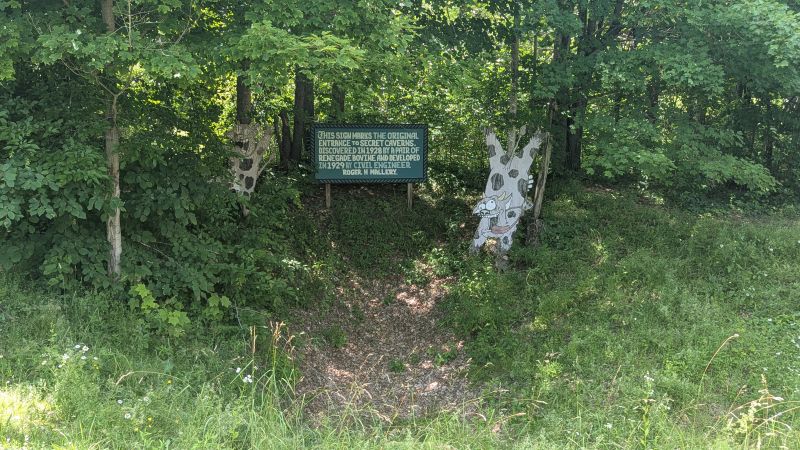
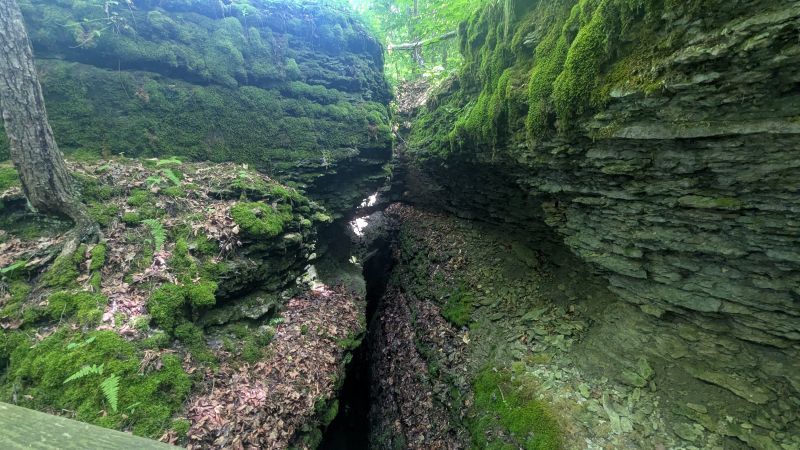
A few steps past that sign, the path just… ends, at a narrow, mossy crevice cut into the rock — not the cave entrance itself, more like a slot canyon in miniature, a few feet wide and dropping straight down into darkness. I honestly don’t know what it’s officially called or what it connects to, but it’s clearly meant to be part of the wait; there’s nothing stopping you from walking up and looking straight down into it. Between the sign and the crevice, the whole detour took maybe eight minutes, and it did a better job of setting the mood than standing around in the parking lot would have.
Down the Steps
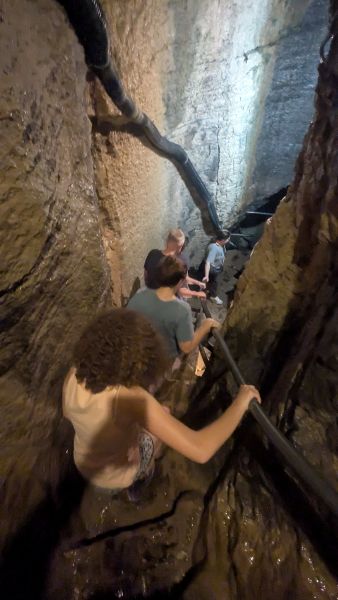
Secret Caverns starts with a descent: 103 rock-and-concrete steps down what the cave, only half-jokingly, calls its “petrified escalator.” The railing was wet, and drops of water were already coming down on us before we’d made it halfway. For my niece, that was the moment things really turned — the unexpected drips and the wet railing caught her off guard more than anyone else in the group. Whatever the reason, once we hit those stairs, there was no getting the day back on track.
She announced, flatly, that she was going back up to wait outside. I reminded her it was well past 100 degrees up there and the cave, whatever else it was, was genuinely cool and comfortable. She stomped, sighed dramatically, and followed us down anyway — grudgingly, but she came.
The Blackout
Our guide was a young guy, probably a teenager or in his early twenties, who mentioned it was his family’s cave. He knew an enormous amount and had stories for nearly everything we passed.
At one point, in a narrow stretch of passage, he told the group to hold still, mentioned we were about to experience total darkness, and then cut the lights almost immediately after. It’s a completely standard moment on cave tours — genuinely the only way to understand how dark true underground darkness is — but it happened suddenly.
What We Actually Saw
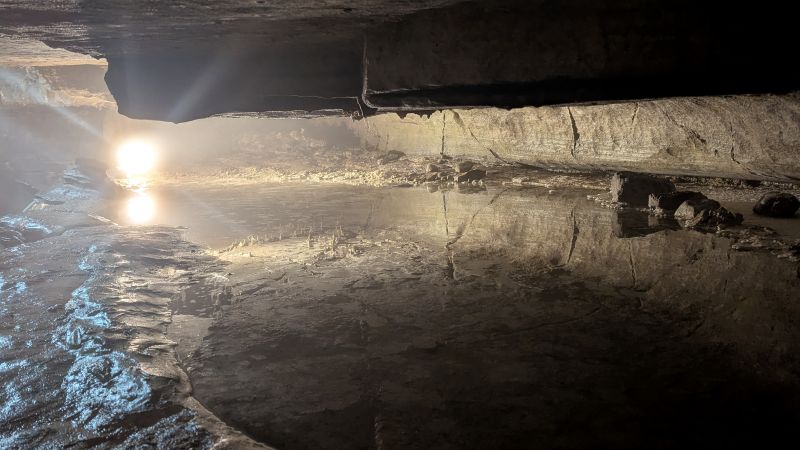
Underneath all of that, the cave itself was genuinely worth the trip. It’s a quarter-mile walk one-way through winding, water-carved passages, past stalactites and stalagmites in every direction. One spot in particular stopped me in my tracks: a small alcove where stalactites hung low over perfectly still water, and the reflection turned the whole thing into what looked like a tiny, glittering underground skyline — a little stalactite metropolis, doubled by its own mirror image. It’s one of those details you can’t really photograph well enough to do it justice.
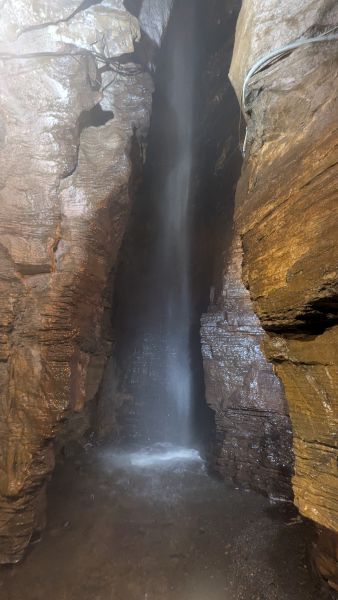
The tour ends at the cave’s signature feature: a genuinely massive underground waterfall, about 100 feet, tucked at the far point of the route before you turn around and retrace your steps back to the stairs. It’s a real, natural formation, not a built feature, and it was the first time I’d personally seen anything like it inside a cave. Worth the whole trip on its own, in my opinion. The guide knows everyone wants photos and generously offered to take the individual group photos. When done, you work your way back up by yourself.
A Little History (and Some Cows)
Here’s the part that made me appreciate the place even more once I looked into it afterward: Secret Caverns and Howe Caverns — the bigger, more polished cave complex just down the road, which my own parents took my siblings and me to when I was around my niece’s age — are actually next-door neighbors, geologically speaking. Both sit in the same limestone bedrock on the Helderberg Plateau, layers of Manlius and Coeymans limestone laid down under an ancient inland sea somewhere between 395 and 435 million years ago. They’re close enough underground that cave researchers have actually traced water flow and confirmed the two cave systems are hydrologically connected.
And both were discovered essentially the same way: livestock falling into them. Howe Caverns dates back to 1842, when a farmer named Lester Howe found his cow enjoying a cool draft coming from a hole in his neighbor’s field. Secret Caverns has a rougher version of the same story — in 1928, two animals, a cow and a bull, wandered too close to a hidden opening and fell roughly 85 feet into the cave below. That accident is what led the farmer to sell the land to a civil engineer, and Secret Caverns opened to the public as a show cave the following year.
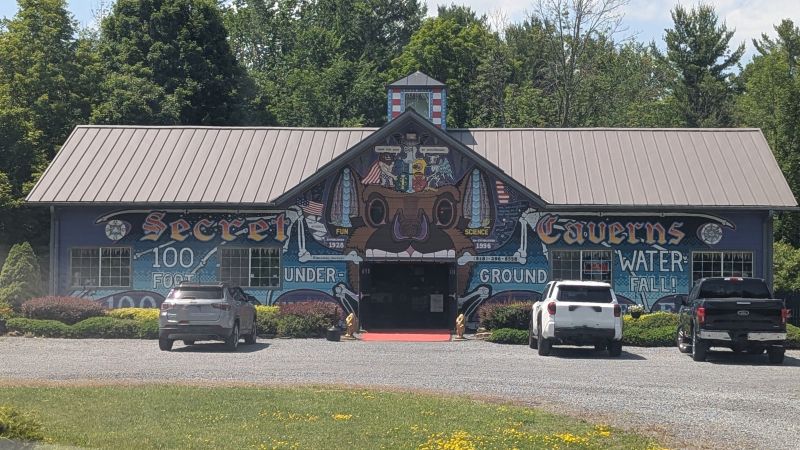
The two caves have taken very different paths since then. Howe Caverns went big — elevators, wide paved passageways, a proper visitor center. Secret Caverns stayed small, a little rough around the edges, and leaned hard into its own kitschy, roadside-attraction charm, right down to the giant painted bat over the entrance. If you went to Howe Caverns as a kid the way I did, Secret Caverns feels like its scrappier, weirder younger sibling — smaller, wetter, a lot less polished, and honestly more memorable for it.
The Verdict
I loved it. My sister loved it. My niece will, to this day, tell you it was the worst experience of her life. All three of those things are true at once, and honestly, that’s kind of the fun of traveling with family — everyone remembers the same hour underground completely differently.

If You Go
- Location: Howes Cave, NY, just down the road from Howe Caverns
- Admission: $20 for adults, $10 for kids 6–12
- Hours: Open daily, 10am–5pm
- Tours: No reservations needed — tours run every hour, on the hour
- What to expect: 103 steps down at the start, a quarter-mile walk to the underground waterfall, then the same route and stairs back up. Expect wet railings and dripping ceilings throughout — this is, hands down, the wettest cave I’ve toured.
- Good to know: If anyone in your group is sensitive to sudden darkness, tight spaces, or unexpected water, it’s worth a heads-up before you go — the lights-out moment happens fast, without much warning.
More info (fair warning, the site itself is a little rough): secretcaverns.com
More from this trip:
- How We Packed 3 Days Full of History & Fun in the Capital Region of NY
- Our Alpaca Hike at Clover Brooke Farm: A Walk That Might Talk You Into Buying Land
- Amsterdam Castle: Crossing “Sleep in a Castle” Off My Bucket List (Sort Of)
- Schuyler Mansion: A Founding Father’s House That Won Over a 12-Year-Old
- 90 Minutes at the Titanic Immersive Experience
- Adirondack Animal Land: Feeding an Emu Through a Car Window