My sister was in the middle of a big road trip and made sure to stop in Denver to see me before heading home. We signed up for a class together, caught up, and honestly spent most of the visit just resting after two weeks of her being on the go.
But on Saturday, after hitting two ARC thrift stores and grabbing lunch, we found ourselves sitting around at noon with no plan. We were talking about her trip and the two caves she went to and loved (Mammoth Cave & Carlsbad Caverns), and I mentioned one just about an hour south, and so we decided to spend the afternoon in Colorado Springs & Manitou Springs. Cave of the Winds, Manitou Cliff Dwellings and Garden of the Gods, since they’re all practically next door to each other. We decided to see the Cliff Dwellings first since we’d have just been in air conditioned car, and this is somewhat outside, thinking we’d need some relief from the hot, the Cave was going to be our second stop, and Garden of the Gods was an add-on.
I threw some drinks in a small cooler and we got in the car for the hour-long drive south. Like the rest of the week, it was high 90s with a clear sky. I realized once we got to the cliff dwellings — our first stop — that my phone was only at 30% and draining fast, and of course I hadn’t brought a charger. By the time we reached the cave it was down to 15%. By Garden of the Gods it was at 2%, and I plugged it into the Halo battery/jump-starter I keep in the car, but the cord is old and slow, so we ended up just carrying the phone around Garden of the Gods on its little tether so we could squeeze out a few more photos. We looked ridiculous walking through the park with my phone tethered by a short cord to a bulky jump-starter block, but desperate times call for golden-hour photos. And when someone offered to take our photo — and explaining the situation, I should have just said no. Note to self: keep a real backup battery in the car or my purse. (The car’s too old to have built-in charging.)
There’s a specific kind of magic to a road trip day that starts with zero plans and an almost-dead phone battery.
Our Itinerary
First Stop: Manitou Cliff Dwellings
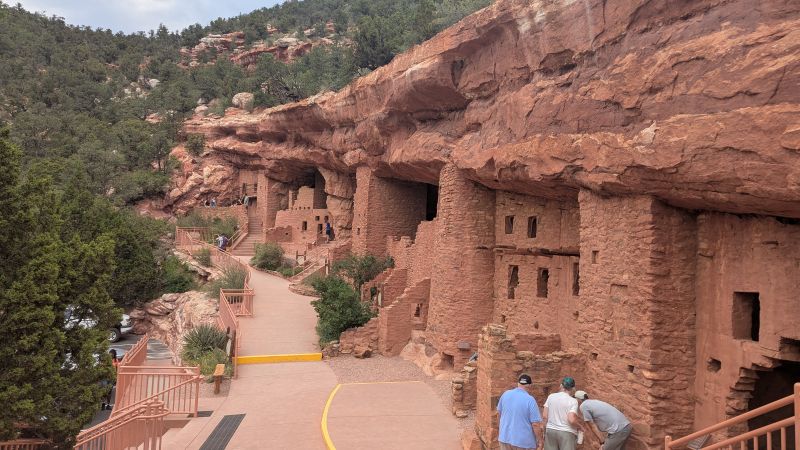
Our first destination was the Manitou Cliff Dwellings, located right off the highway in Manitou Springs. After paying at the gate, you drive right up to an incredible view of the structures situated just beyond the parking lot. (Though I do think the lot is a little too close to the structures — makes it easy for everyone to see, at least.)
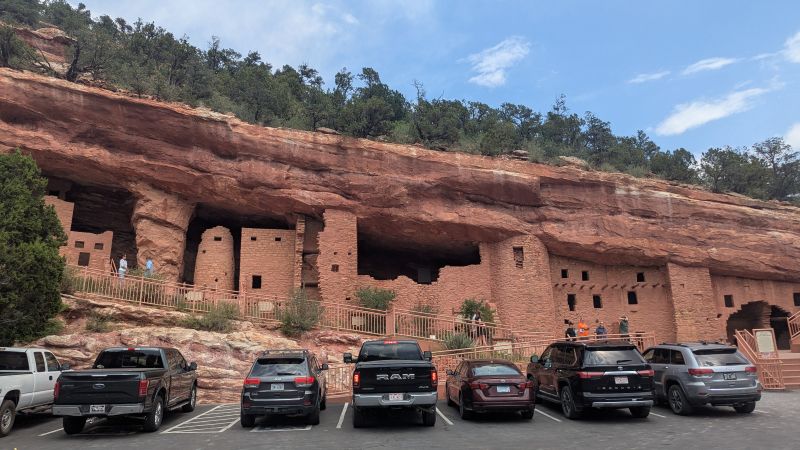
What surprised me is that this isn’t actually an ancient site in situ. The stonework was originally part of Ancestral Puebloan structures near McElmo Canyon in southwest Colorado, close to Mesa Verde, dating back roughly 700–1,000 years. In the early 1900s, preservationist Virginia McClurg and her associates — worried about looting and vandalism at the original sites — had them carefully relocated to Manitou Springs between 1904 and 1907 by dismanting, shipping by rail and wagon to Manitou Springs, and reassembled here in what’s now called Cliff Canyon. So what you’re walking through is a genuine assemblage of centuries-old stonework, just rebuilt about 120 years ago in a new canyon chosen because its sandstone overhangs and southwest-facing wall mimic the original landscape. It’s a bit of a strange history when you learn it, but the craftsmanship itself is real.
The Ancestral Puebloan Architecture
The architecture is a marvel of ancient engineering:
- Materials: Built using hard sandstone blocks bound together with a mortar made of clay, sand, and water.
- Living Spaces: Multi-story residential rooms, structural support pillars, and storage units built directly underneath the protective overhang of the canyon wall.
- Towers & Vents: Round and square towers used for lookout points, alongside small, square windows that provided ventilation for indoor cooking fires while keeping the elements out.
Going Inside the Ruins
Unlike many strictly preserved national parks, a unique aspect of this stop is that visitors are actively encouraged to walk through and explore inside the rooms.
Walking through the narrow doorways and climbing up the viewing platforms offers a firsthand perspective on how these ancient communities utilized sandstone shelters to stay cool in the summer and shielded from winter winds. The ladders you see leaning against the walls are reproductions of the kind Ancestral Puebloan builders would have used to move between rooms and rooftop levels — many of these structures didn’t have ground-floor doors at all, for defense.
The Museum Artifacts
After exploring the exterior, we headed into the three-story Pueblo-style museum and gift shop. We spent a surprising amount of time in the museum and gift shop — maybe more than we spent outside. The museum houses a small collection of historical Native American tools, clothing, and pottery.
Among the displays are beautifully preserved pottery vessels from various Southwest cultures:
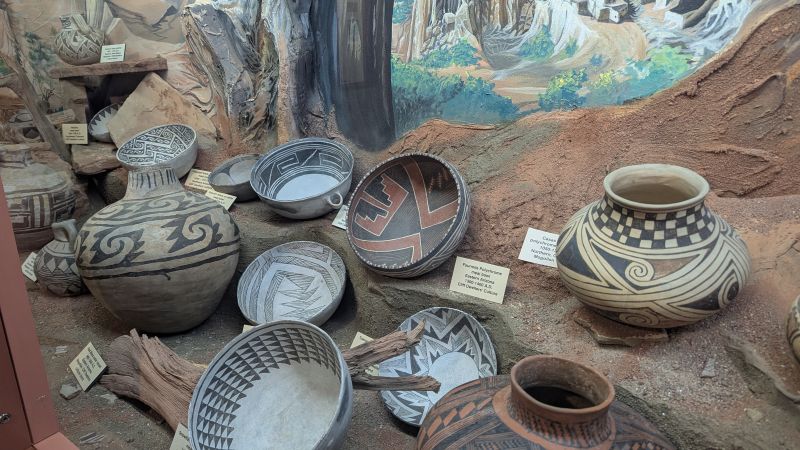
- Zuni Pueblo Bowls: Large, shallow meal bowls characterized by intricate geometric line work, geometric bands, and symbolic water bird or “rain bird” motifs painted in black and white slip.
- Acoma Pueblo Jars: Highly detailed water jars and canteen vessels featuring tight, fine-line monochrome abstractions and traditional orange and black polychrome accents on a white clay base.
- Hopi Pueblo Pottery: Traditional low-slung bowls and jars displaying hand-coiled asymmetry and earth-toned geometric patterns representing natural elements.
Seeing the intricate geometric line work up close makes you realize how much artistry was woven into everyday objects that were built purely to hold water and grain.
Like a lot of popular spots, there was one group turning their visit into a full-blown photo shoot. I’m all for everyone getting their photos — but please, don’t hog the best spots and glare at people just trying to walk past. Be aware of others, be civil, share the space.
Second Stop: Cave of the Winds
Just a short drive up the canyon from the dwellings sits Cave of the Winds Mountain Park. The drive up & down overlooks the Williams Canyon below—fair warning for anyone prone to vertigo, as my sister had to look strictly away from the window and practically refused to sit/wait on the Adirondack chairs! For someone who was clutching the car seat in terror on the steep cliffside up and down Williams Canyon, the second we stepped out of the cave she was literally jumping up and down shouting how much she loves caves.
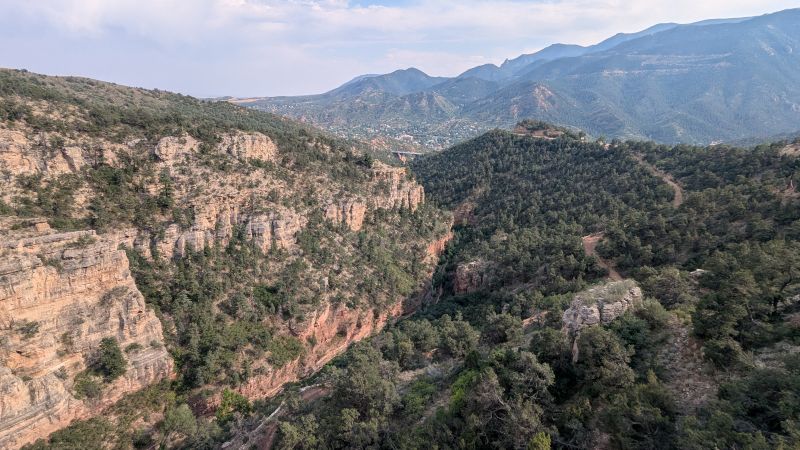
While the park offers high-adrenaline outdoor attractions like the “Terror-dactyl” canyon swing, ziplining, via ferrata, and a cliffside ropes course, we opted to stay underground and booked the standard Discovery Tour. We lucked out with a small group of just 12 people compared to the massive crowds packed into other timeslots.
The cave is about 54 degrees year round, providing a respite from the heat.
Subterranean Formations
The 45 minute tour descends into a cave carved out of Manitou Limestone, rock that’s roughly 500 million years old. The cave itself is much younger — geologists think the passages started forming only 4 to 7 million years ago, once this limestone bed sank below the water table and rainwater mixed with carbon dioxide to slowly dissolve pockets and passageways out of the rock. Once the water table dropped again, air got in and the real decoration began: stalactites growing down from the ceiling, stalagmites growing up from the floor, and flowstone draping over walls in sheets. It’s almost absurdly slow work — it takes roughly 800 to 1,000 years for a stalactite or stalagmite to grow just one inch.
The guide takes you through a 1/2-mile concrete path that is packed tight with spectacular, ancient geological formations:
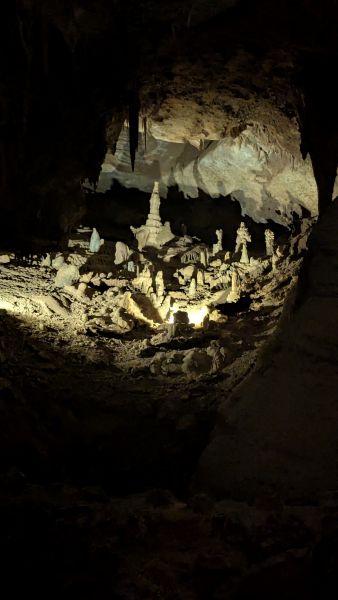
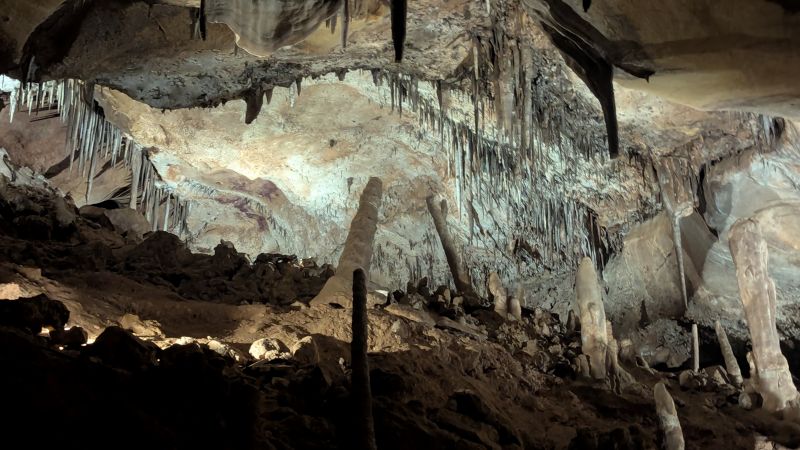
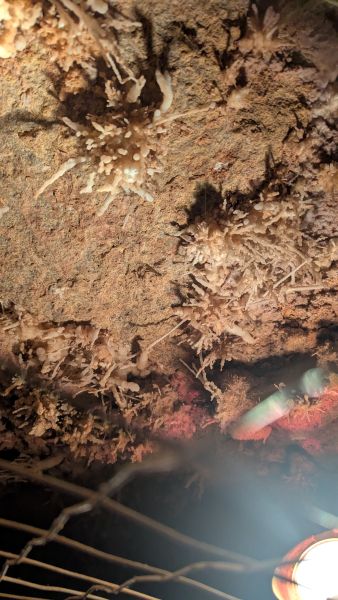
- Stalactites & Stalagmites: Pointed mineral deposits hanging tightly from the ceiling (stalactites) and corresponding pillars growing upward from the cave floor (stalagmites) created by centuries of dripping water.
- Cave Bacon: Scientifically known as draperies, these are thin, translucent sheets of calcite that form along sloping ceilings, creating bands of dark iron-oxide and light minerals that look exactly like strips of breakfast bacon.
- The “Metropolis”: A dense, lit-up cavern floor filled with hundreds of small, closely clustered stalagmites and flowstone mounds that resemble a miniature subterranean city skyline.
- Helictites & Popcorn: Intricate, twisting calcite straws that defy gravity by growing in curved or erratic directions due to capillary action, alongside rough, bumpy “cave popcorn” textures clustering on the walls.
If I go back, I might be tempted by the Lantern Tour — not because I need ghost stories, but exploring by lantern light alone sounds like a genuinely different experience.
Third Stop: Garden of the Gods
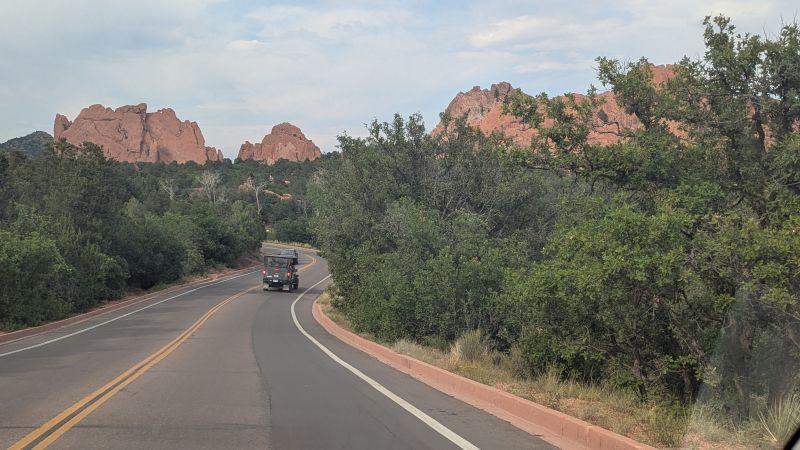
Our last stop was somewhere we’d both already been, about nine years ago: Garden of the Gods. The park is free. We parked in Lot 2 (near the restrooms) and walked into the interior of the park.
Geology of the Red Rocks
The dramatic landscape of Garden of the Gods is a masterclass in tectonic geology:
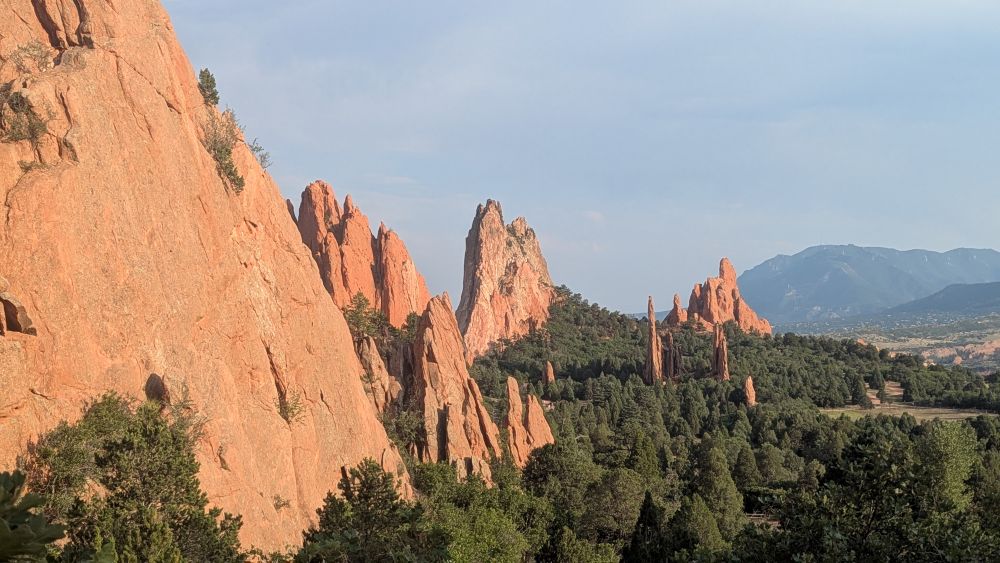
The towering red rock formations here are sandstone and conglomerate, tilted up on edge by the same mountain-building forces that pushed up the Rocky Mountains millions of years ago — the layers were originally laid down flat and later tipped nearly vertical, which is why the spires look like giant fins jutting out of the ground rather than ordinary cliffs. The deep rust-red color comes from iron oxide in the rock. Scattered among the formations are pinyon pine and juniper, tough, drought-tolerant trees that seem to grow straight out of bare rock.
- The Rock Type: The massive vertical fins are composed of Lyons Sandstone, a bright orange-red sedimentary rock formed roughly 300 million years ago from ancient, compressed sand dunes.
- The Uplift: The rocks were originally flat, horizontal layers. During the ancestral Laramide Orogeny—the massive mountain-building event that created the Rocky Mountains—the earth’s crust buckled, tilting these heavy sandstone beds completely vertical into the jagged fins seen today.
- The Formations: Over millennia, wind, rain, and freezing water eroded the softer stone, carving out famous landmarks like the Kissing Camels window visible high along the ridge lines.
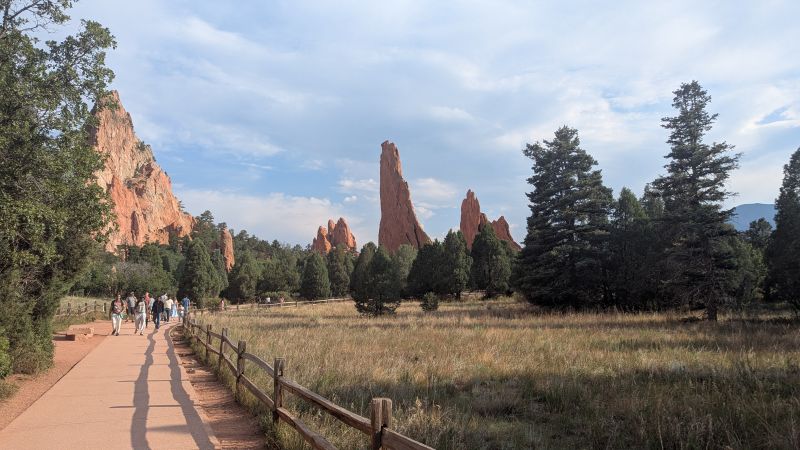
We admired the rock formations, watched the birds — we spotted a blue one, probably a Steller’s jay or a mountain bluebird — and just wandered the paved paths as the light got warmer toward evening.
High-Desert Vegetation
The park sits at a unique ecological crossroads where the Great Plains meet the Rocky Mountains, resulting in a distinct mix of high-desert flora:
- Pinyon-Juniper Woodlands: The hillsides are covered in hardy, twisted Utah Juniper and Pinyon Pine trees capable of thriving in dry, rocky soil.
- Scrub Oak: Thick clusters of Gambel Oak line the pathways, providing crucial nesting habitats for local birds.
- Yucca & Cacti: Sharp, spiky Soapweed Yucca plants and prickly pear cacti dot the sandy trailside soil, well-adapted to the hot, arid summer climate.
A Quick Altitude Check: Garden of the Gods sits at roughly 6,400 feet above sea level. Even if you consider yourself fairly fit, the thinner air catches up with you fast. Take the paved paths at a slower pace than usual, drink far more water than you think you need, and don’t feel bad taking frequent breaks to “take in the views” (and catch your breath).
If We Had More Time
We left around 6 pm to drive home. If I’d planned it out further in advance, I would have considered a few other places to go froWe left around 6:00 PM to drive back to Denver, but if we’d had a full day down here, these would be at the top of my list since I haven’t yet done them:
- Miramont Castle: Take the tour and maybe do the tea.
- U.S. Air Force Academy: Taking a self-guided tour of the USAFA grounds and visitor center (just remember to bring a valid REAL ID/passport for entry).
- Olympic Training Center: Take the guided 75 minute tour
- Downtown Manitou Springs & SunWater Spa: Strolling through town to sample the natural mineral fountains, or soaking in cedar tub mineral baths with outdoor deck views of Pikes Peak.
- The Manitou Springs Penny Arcade: A sprawling downtown complex filled with hundreds of working retro pinball machines and 1900s mechanical games—many still costing just a nickel or dime.
- Glen Eyrie Castle: General William Jackson Palmer’s historic 1901 Tudor-style castle, tucked into a hidden canyon right next to Garden of the Gods (where bighorn sheep frequently graze on the lawn).
- Red Rock Canyon Open Space: Located right across Highway 24 from Garden of the Gods, offering similar vertical red sandstone formations with a fraction of the crowds.
- Broadmoor Seven Falls: A series of seven cascading waterfalls tucked inside a granite canyon, accessible via a canyon walk or short tram.
- Historic Museums: Quick stops like the indoor Ghost Town Museum, or the Western Museum of Mining & Industry.
All in all, our afternoon in Colorado Springs & Manitou Springs was a very full day for something that started as “well, what do we do now?”
Post from the same weekend: