
If you’ve scrolled past the ads for one of these “immersive art experiences” and wondered whether they’re actually worth your money, you’re not alone. I’ve now done two — the Titanic immersive exhibit in New York earlier this year, and most recently, the Van Gogh Immersive Experience at the Exhibition Hub Art Center in Denver. Here’s my full rundown, including what I loved, what I’d skip, and what I wish someone had told me before we bought tickets.
The Basics
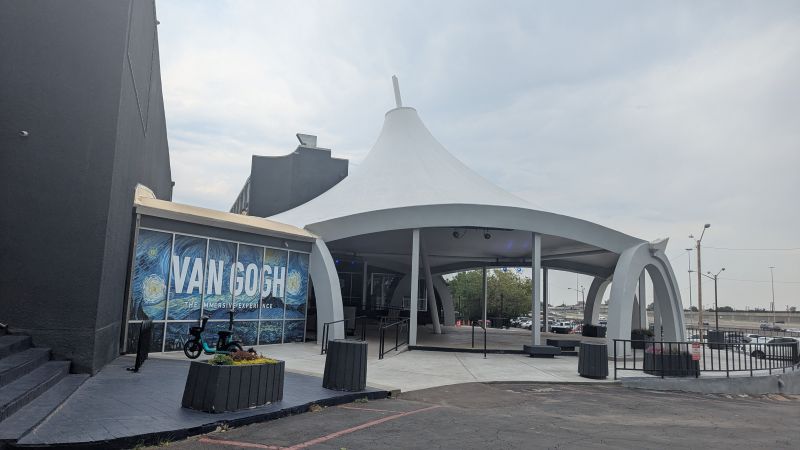
- Where: Exhibition Hub Art Center, 3900 Elati St, Denver, CO (This is a traveling exhibit through many cities — so you may get one near you)
- When: August 2026
- Price: $36.90 per person for a basic adult ticket (weekend pricing)
We didn’t buy tickets in advance. We weren’t sure exactly what time we’d get there, and when we checked online ahead of time there were plenty of slots still open, so we decided to just wing it and buy at the door. That worked out fine for us, but if you want more flexibility or peace of mind, buying ahead is always the safer bet. One thing worth noting: a few days after our visit, we noticed the website had a 20% off banner that wasn’t there when we bought our tickets. Do a quick search for a coupon code before you check out — it could save you a decent chunk of change for a family or group.
Getting There
Parking was free, which is always a nice surprise these days. The signage directing you into the parking lot was clear enough, but once we parked, there was no sign pointing us toward the actual entrance — and you can’t see it from the visitor parking area. We had to do a little wandering before we figured out that it was on the east side of the building.
Walking Through the Van Gogh Immersive Experience Exhibit
The experience is broken into a series of rooms, each with a different focus, and you move through them at your own pace. The site says its about 60-90 minutes.
Van Gogh’s Story and Letters
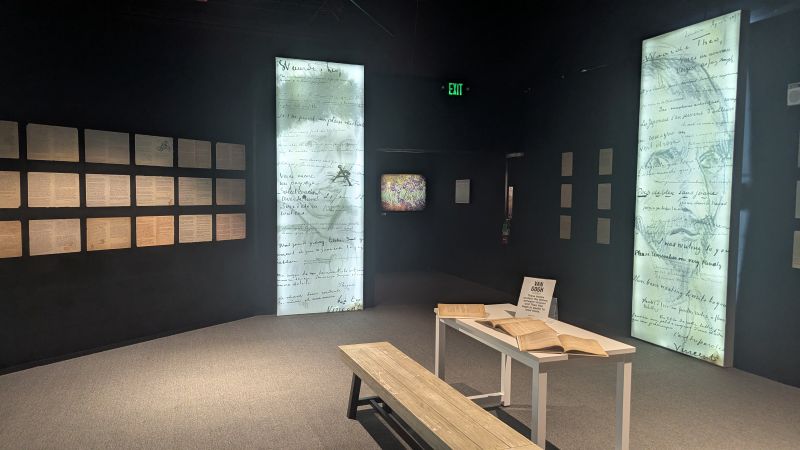
It starts off simple — a bit of reading about Van Gogh’s life, a handful of photos, and then the first big room, which is dedicated to the correspondence between Vincent and his brother Theo. The letters are displayed on the walls, but thankfully there are also a few printed, typed books of the letters, which were much easier to actually sit and read than squinting at the wall text. We spent about 10 minutes in this room going through a variety of the letters, and honestly, this was one of the more meaningful parts of the whole visit — it’s the closest the exhibit gets to really getting inside his head.
Sunflowers and Portraits
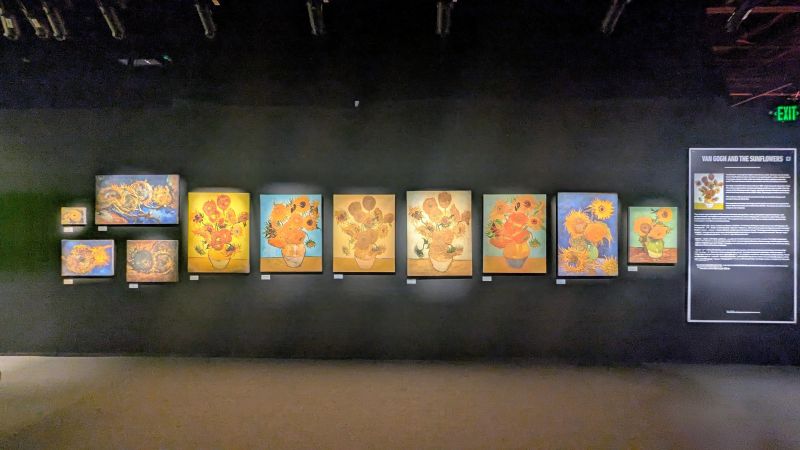
From there, you move into a hallway-style area lined with reproductions of his most famous works in a row — the sunflower paintings, of course, his self-portrait with the bandaged ear, and his final painting. There was a vase that changed through his sunflower works also, that was very cool. Worth remembering going in: none of these are originals. This is purely a printed/projected art experience, not a museum with actual canvases.
The Bedroom Photo Op
Next up is a room with a few different photo-op setups, and this was a fun one — a re-creation of Van Gogh’s bedroom that you can actually sit in, either in the chair or on the bed. It’s a nice, tactile break from just walking and reading, and it made for some good photos.
The 360-Degree Room
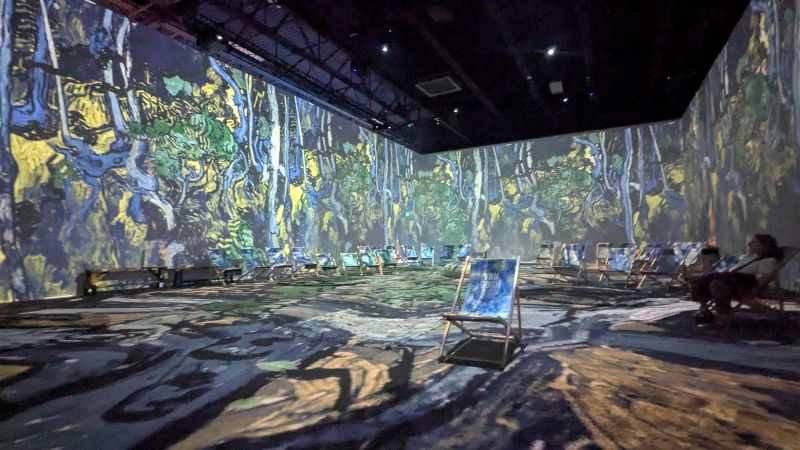
From here, you walk into a large space with wall-to-wall projected imagery, heavily influenced by Japanese art styles that inspired Van Gogh’s later work. We’re honestly not sure how long the loop runs — we stayed for maybe 10 to 15 minutes, but the room was so hot that we decided to move along before seeing it repeat.
A Small Sunflower Room
After that is a smaller, more intimate room filled with sunflowers against mirrored walls. It was a nice change of texture and space.
The Big Immersive Room
This is the main event, and it’s a large room with a wall-to-wall, floor-to-ceiling projection that runs for about 30 minutes. “Movie” isn’t quite the right word for it — it’s more like his paintings brought to life through slow, moving imagery, cross-fading from one piece to the next, set to music.
Virtual Reality Experience
After the big room, there’s a virtual reality experience available for an additional cost/upgraded ticket, which we opted to skip. This was one where you stay seated in your stool.
Coloring Room
Near the end, there’s a room where you can sit down and color one of his paintings — a nice, low-key way to wind down before heading out. The crayons were large and waxy with only about 5 colors. We each ended up picking a different image and spent maybe 8-10 minutes coloring.
Right outside the coloring room was a projection of Van Gogh himself talking….a little creepy, but kinda neat at the same time.
We spent about 2 hours total at the exhibit, moving at a fairly relaxed pace.
What I Really Thought about the Van Gogh Immersive Experience
This was my second immersive exhibit of the summer — I also did the Titanic immersive experience earlier this year while visiting New York. Between the two, I’m starting to notice a pattern: these experiences seem to define “immersive” as mainly being in a huge room with floor-to-ceiling moving images, more than anything deeply interactive or story-driven.
The Van Gogh exhibit does lean into his actual art more than I expected going in, which I appreciated. But I would have liked more about his life, his family, and what inspired specific pieces — the letters room hinted at that kind of depth, and I wanted more of it woven throughout the rest of the experience instead of it being confined to one room near the start.
I should mention I wasn’t walking in as a total blank slate — I already knew some of his work, and last year I read Saving Vincent by Joan Fernandez, a historical fiction novel. And honestly, I learned more about who he was, his relationships, and what drove his art from that novel, which was more about the struggles of his sister in law trying to sell his paintings, than I did from two hours inside this exhibit. That’s not necessarily a fair comparison — a book has the luxury of hundreds of pages to build out a person’s inner life, while an immersive exhibit is built around visuals and spectacle. But it did highlight for me how much this experience is designed as an art-and-atmosphere showcase rather than a biography. If you go in already curious about the man behind the paintings, I’d recommend pairing this with a good book or documentary beforehand — it’ll add a layer of meaning to the rooms that the exhibit itself doesn’t quite provide.
My biggest critique is about the loop stories. There’s no sign or notice anywhere telling you how long the loop actually runs. You walk in, it’s genuinely cool for the first several minutes, and then you’re left wondering: how long am I supposed to stand/sit here? For this one, there were two rooms with videos, I don’t know about the first one, but the second loop was about 30 minutes, and realistically, most people are not going to watch the whole thing start to finish. The pacing also felt slow at times. About 15 to 20 minutes in, I found myself thinking, “well, now I have to see this through since we paid for it,” which is not really the reaction you want from your centerpiece room. It shifted from feeling fun to feeling like an obligation — and for a ticket that isn’t exactly cheap, that’s a letdown.
The other thing worth mentioning: the day we visited, the air conditioning in the building was broken. Nobody told us this when we bought our tickets at the counter. When we were leaving, I mentioned to a staff member that it was really warm in there, and that’s when they explained the A/C was down. Had we known that going in, we could have planned differently — worn lighter clothes, kept the sweater in the car (usually these places are colder), brought water, maybe paced ourselves differently through the rooms. A simple heads-up at the ticket counter would have gone a long way.
One more practical note: the seating provided in the big projection rooms is a low-slung canvas sling chair, similar to a beach or lounge-style folding deck chair. This allows you to have your head back a little to really see the large wall without neck strain. I was fine getting in and out of them, but they sit fairly low to the ground and don’t offer much support getting up. If you’re visiting with older parents or grandparents, or anyone who has trouble with mobility or getting up from a low seat, this could be a real obstacle. There was a few benches against the wall, and aside from a few large beanbags, I didn’t see a sturdier chair as an alternative.
Bottom Line
If you’re a Van Gogh fan, or just curious about this style of immersive exhibit, there’s enough here to make it a fun hour or two out of the house — the letters room and the bedroom photo-op were genuine highlights for us. Just go in with realistic expectations: it’s more walk through big rooms with his art projected around you than a deep biographical experience, the big room’s loop is long, and it’s worth checking for a discount code before you buy. And if you happen to visit on a hot day, maybe ask at the counter if the A/C is working before you commit to two hours inside.
Similar posts: