Getting around Spain is incredibly easy. The country has an expansive, efficient network of trains to choose from, making ambitious day trips feel entirely within reach. While we were based down in Málaga, we decided to hop on a morning train and head inland for a day trip to Ronda.
But like all travel adventures, you simply cannot control the weather.
Our Day Trip to Ronda
When “Downpouring” Isn’t a Strong Enough Word
As the train made its way to Ronda, we noticed it was raining…and when our train pulled into the station, it was more of a downpour. We had packed our rain jackets, but they were nowhere near enough for what greeted us. I mean, what is worse than downpouring? A torrential, sideways sheets-of-water kind of rain.
The second we stepped off the train, the climate claimed victory. We managed to walk exactly one block before having to duck into a café just to escape the immediate deluge and to see if the weather was going to pass. Justin ordered a coffee to warm up, but the damage was done—our clothes were already completely soaked through. We sat in the cafe wondering how were were going to pivot. We had pre-booked our train tickets with specific start and return times, giving us a full day to explore. Yet, only 15 minutes into our adventure, we looked at each other and realized there was no way we could last hours out in this misery, our day trip to Ronda was going to be short.
Sucking It Up for the Puente Nuevo
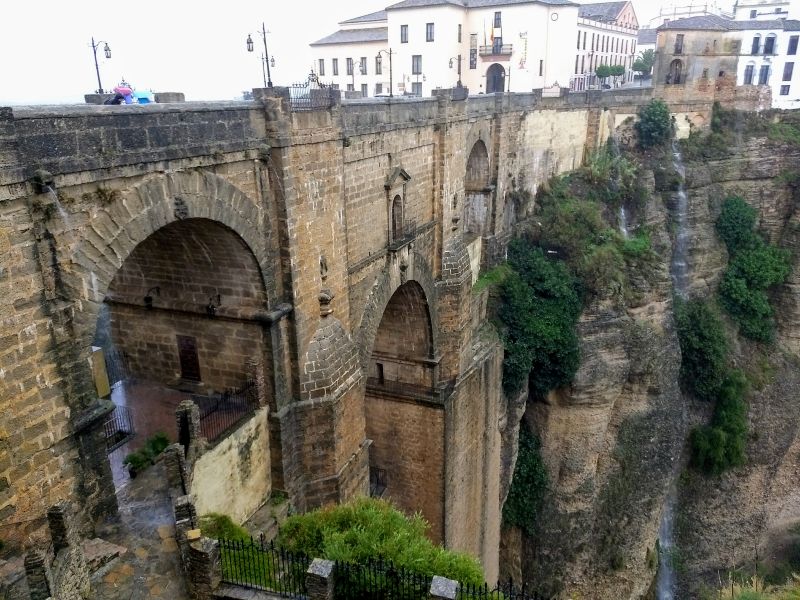
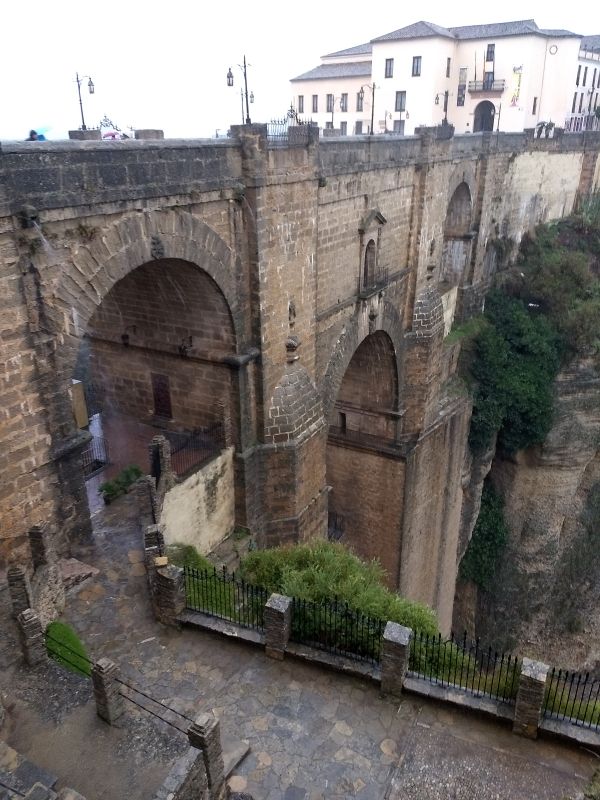
Because we were already there, we decided to suck it up and at least see one main attraction. We braced against the wind, walked over to the breathtaking Puente Nuevo, and looked down into the churning abyss of the El Tajo Gorge.
The Puente Nuevo — literally “new bridge,” though it completed construction in 1793 — is the dramatic three-arched stone span that connects Ronda’s old town (La Ciudad) to the newer mercantile district that grew up on the other side of the gorge. It stands over 300 feet above the Tajo gorge floor, and looking straight down from its walls is not for the faint of heart. The bridge wasn’t the first attempt to cross the gorge here — an earlier version was thrown up hastily in the early 1730s and collapsed within six years, killing around 50 people. Its replacement, designed by architect José Martín de Aldehuela, took 42 years to complete and required a construction foreman inventive enough to design specialized machinery just to haul massive stone blocks up from the bottom of the gorge. Tucked inside the central arch is a small chamber that served at various times as a prison and, during the Spanish Civil War perhaps something far darker.
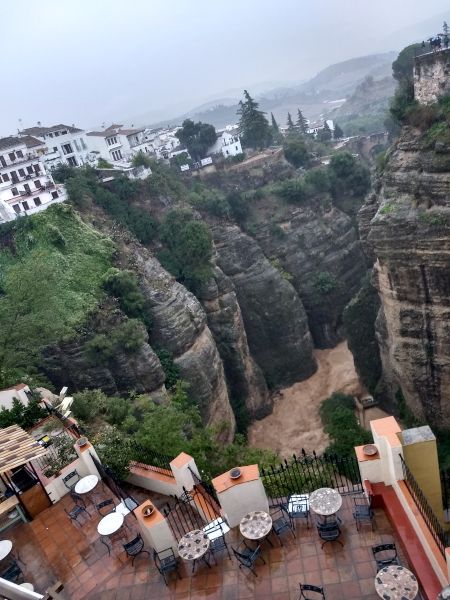
Normally, the Guadalevín River flowing below is a regular river, but the storm had turned it into a raging, muddy brown torrent slicing through the cliffs. The view was hauntingly beautiful, but capturing it required a serious battle with the elements. We quickly snapped a few photos from the slick stone viewpoints, watching the mist roll right out of the canyon.
Defeat, Regret, and Retooling the Wardrobe
With our photos secured and our bodies shivering, we immediately headed back to the train station to throw ourselves at the mercy of the ticket counter. Fortunately, the agents were incredibly understanding and allowed us to exchange our tickets to get on the very next train back to Málaga.
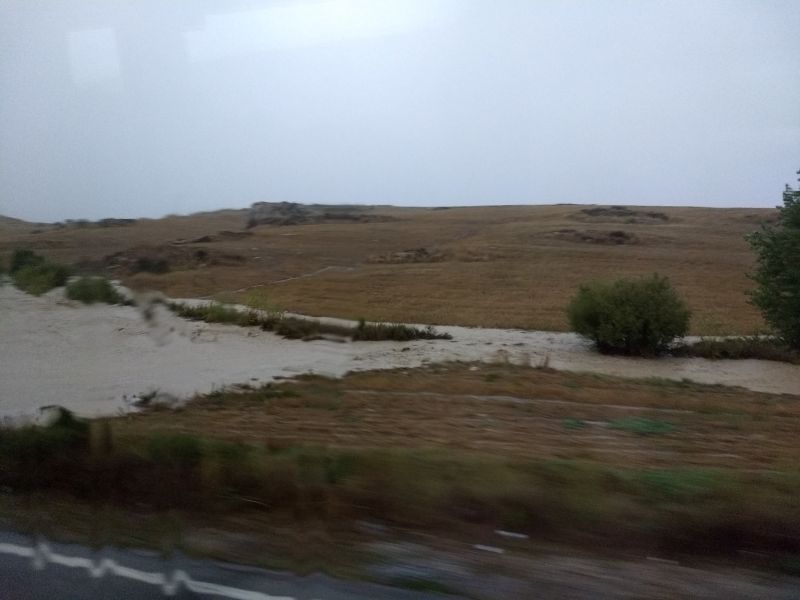
Looking out the windows of the train, I was happy we left. Even the fields were beginning to flood.
The 2-hour train ride back was pure misery. We sat there cold, wet, and thoroughly defeated. The moment we got back to our apartment in Málaga, we stripped out of our soggy layers and changed into dry clothes. It took a full three days for my leather boots to dry out completely.
Ok, I know what you are probably thinking… it’s just rain. Well, I actually had to look it up later because it felt completely unprecedented. On the exact day we were there, October 21, 2018, Ronda, Spain recorded a massive 8.7 inches of rain. This extreme deluge was part of a historic gota fría (cold drop) storm system that swept through the province of Málaga, causing severe flash flooding and swelling the Guadalevín River inside the town’s famous El Tajo gorge to terrifying levels.
Even though we got caught in a “once-in-a-decade” weather anomaly, we certainly learned our lesson on that day trip to Ronda. The second we got back home, we hopped online and ordered proper rain pants and heavy-duty waterproof hiking shoes. It was a soggy wakeup call, but we refuse to let a little (or a lot of) rain ruin a trip ever again!
What We Missed
Because our trip was cut so incredibly short, we missed out on everything else this historic city has to offer. The whole point of Ronda is to wander its outdoor architecture, and if the weather co-operates, there is so much more to see beyond the bridge. If we end up in the area, we’d definitely still try for a day trip to Ronda to see:
- The Plaza de Toros: One of the oldest and most architecturally significant bullrings in Spain.
- The Arab Baths (Baños Árabes): Incredibly preserved 13th-century subterranean thermal baths located in the old Jewish quarter.
- Mondragón Palace: A 14th-century Moorish palace featuring beautiful courtyards, water fixtures, and the municipal museum.
- The House of the Moorish King (Casa del Rey Moro): Where you can actually climb down a water mine of 200+ steps cut directly into the stone of the gorge face.
- The Puente Nuevo: there is the Puente Nuevo Interpretation Centre, where visitors can explore the room directly above the central arch.
Check out the other posts related to this trip:
- 12 day Itinerary: Barcelona, Málaga & Madrid — Fun Days of Tapas, History & Cava
- Day Trip From Barcelona: Montserrat and Oller del Mas Tour Guide
- Visiting the Teatro Romano and Alcazaba in Málaga: Two Thousand Years in One Afternoon
- Eating In Spain: Tapas, Jamón, Cava & a Cooking Class That Changed Everything
- Day Trip to the Rock of Gibraltar from Málaga
- Is it Gaudi or Gaudy? A 2018 Tour of Barcelona’s Wildest Masterpieces