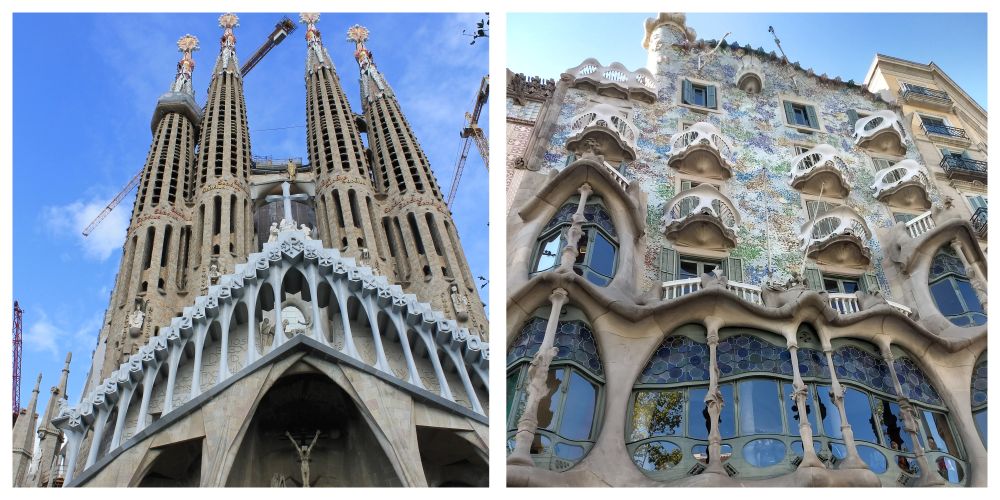
We are just a few weeks out from our autumn 2018 trek through Spain, and if there is one city that completely rewrote our understanding of what architecture can be, it is Barcelona. The city is a living canvas, but one particular man’s thumbprint is pressed so deeply into its streets that you can’t look anywhere without seeing his organic, hallucinatory style.
As we walked through the heart of the city, we couldn’t help but notice a hilarious linguistic coincidence. The buildings here are intricate. They are experimental. They are entirely over-the-top, deeply maximalist, and borderline flamboyant. In English, the word for that is gaudy.
How brilliantly funny is it, then, that the legendary visionary mastermind behind these structures is none other than Antoni Gaudí? It feels like a cosmic joke or a historical case of nominative determinism. Whether you find his style beautifully divine or delightfully surreal, a tour through his portfolio is an absolute mandatory rite of passage when visiting Catalonia. So let’s find out, is it Gaudi or Gaudy?
Part I: The Endless Masterpiece – La Sagrada Família
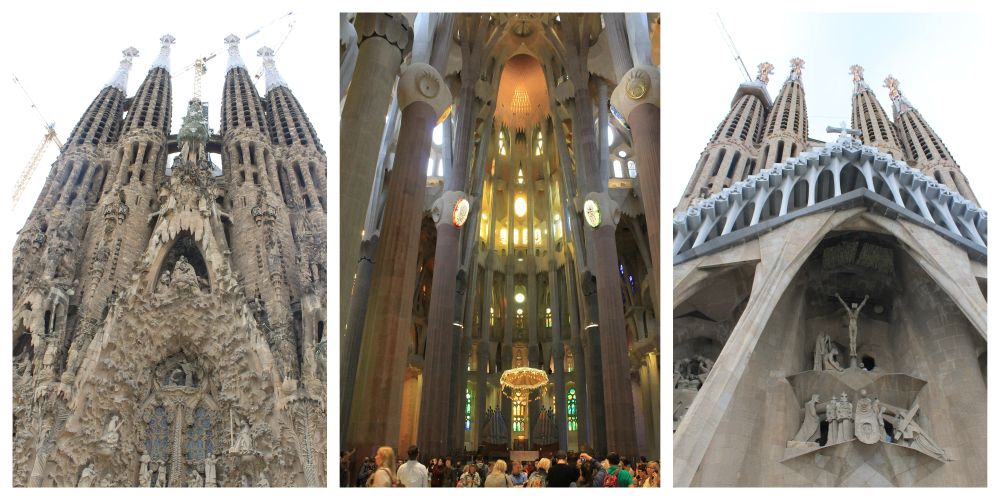
You cannot talk about Barcelona without talking about the Basílica de la Sagrada Família. It is the crown jewel of the city, a towering forest of stone that has been under continuous construction since 1882. Standing across the street just a few weeks ago, looking up at the massive scaffolding and giant construction cranes balancing precariously over the sky-high spires, the sheer scale of the project hits you. It has already taken decades to build, outliving its creator by nearly a century. Rumor has it that they are aiming for a completion date somewhere around 2025 or 2026 to mark the centenary of Gaudí’s death. Standing there in the dust of active stonemasons, it feels wild to think we are witnessing a piece of history still being born.
We did the full audio and tower tour, and the exterior facades alone could occupy an art historian for a lifetime. The Nativity Facade, which Gaudí oversaw personally, looks like a cave made of melting wax or a sandcastle sculpted by an ocean wave. It is erupting with life—sculptures of flora, fauna, and biblical figures look less like carved stone and more like organic matter growing straight out of the mountain.
Turn the corner to the Passion Facade, and the style completely shifts. It is harsh, skeletal, and angular, defined by sharp lines that evoke a sense of deep sorrow and sacrifice.
For the grand finale of our tour, we took a tiny elevator high up into the towers to look down on the city. The descent, however, requires walking down a tight, vertigo-inducing spiral staircase. Built to mimic the geometry of a snail shell, the stone steps coil tightly down into the dark abyss. Peeking over the tiny stone ledge down the center of the spiral gives you a true appreciation for the mathematical genius behind the art.
Part II: Downtown Whimsy – The House Tour at Casa Batlló
After wrapping up at the basilica, our architectural treasure hunt led us straight into downtown Barcelona along the glamorous Passeig de Gràcia. We were eager to see how this strange, naturalistic style translated into a residential space. Sure enough, we found ourselves standing in front of another mind-bending structure that shared that exact same unmistakable DNA. And yes, it absolutely was designed by the very same master of the unconventional: Antoni Gaudí.
Welcome to Casa Batlló, locally known as Casa dels ossos (The House of Bones).
If you think a church styled after a forest is wild, seeing a 19th-century luxury apartment remodel styled after marine life and old Catalan folklore is next level. The exterior facade of the house looks like it was made from iridescent fish scales, glittering with broken ceramic mosaics (trencadís) that shift color from green to blue under the Spanish sun. The balconies look suspiciously like stone skulls or masquerade masks, while the heavy pillars on the lower floors resemble the literal bones of a prehistoric creature.
Inside, the wavy, ocean-inspired theme continues. There isn’t a single flat wall or sharp corner to be found. The ceilings swirl like whirlpools, the wooden doors look like ripples in water, and the central lightwell is covered in shades of blue tiles that darken as you go up, ensuring the sunlight distributes perfectly down to the lower floors. The roof looks like the arched spine of a great mythical dragon, complete with colorful ceramic tiles acting as its scales.
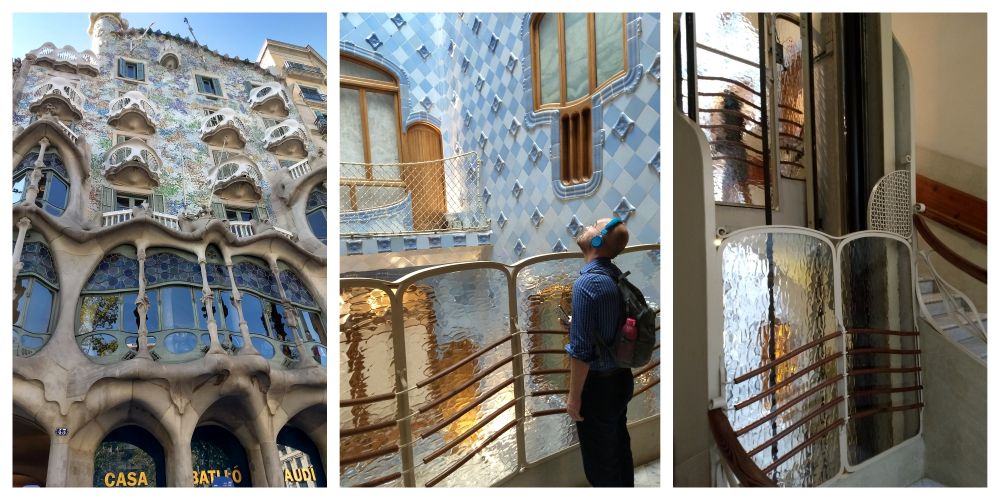
The Verdict: Gaudi or Gaudy
So, is Gaudí’s work gaudy? By the truest definition of the word—tastelessly showy or brightly design-heavy—some critics over the past century have certainly argued yes. It is loud, it is eccentric, and it unapologetically rejects the clean, minimalist lines that define much of modern European design.
But seeing it in person may change your perspective entirely. There is a deep, mathematical rhythm to his madness. Every curve serves a structural purpose, and every splash of color captures a specific angle of natural sunlight. It isn’t cheap showmanship; it is a profound love letter to the natural world, translated into stone, iron, and glass.
Walking away from our double-feature day of architecture, our eyes were spinning but our hearts were full. Barcelona wouldn’t be Barcelona without the beautifully bizarre, slightly “gaudy” genius of Antoni Gaudí. If you go, book your tickets well in advance, keep your eyes glued to the ceilings, and prepare to see the world a little bit differently!
Check out the other posts related to this trip:
- 12 day Itinerary: Barcelona, Málaga & Madrid — Fun Days of Tapas, History & Cava
- Day Trip From Barcelona: Montserrat and Oller del Mas Tour Guide
- Visiting the Teatro Romano and Alcazaba in Málaga: Two Thousand Years in One Afternoon
- Taming the Tapas: Cooking Classes, Late Nights, and the Ham That Changed My Mind
- Ruined by Rain: Our Soaked, Short-Lived Day Trip to Ronda
- Day Trip to the Rock of Gibraltar from Málaga