During our 5 day stay in Malaga, we made sure we visited the Teatro Romano and Alcazaba in Málaga. There is something incredibly special about these two places.
If you are a history lover who needs to physically see things to truly process their scale, Málaga is the ultimate playground. Standing at the base of the hillside in the middle of downtown, you are looking at over a thousand years of overlapping history — layered, quite literally, right on top of each other.
Jump To
Exploring the Ancient Teatro Romano
When you are wandering through the bustling downtown area of Málaga, you don’t have to search hard to find its ancient past — you walk right into it. The Teatro Romano (Roman Theatre) sits proudly at the foot of the Alcazaba hillside, a striking reminder of the city’s deep historical roots.
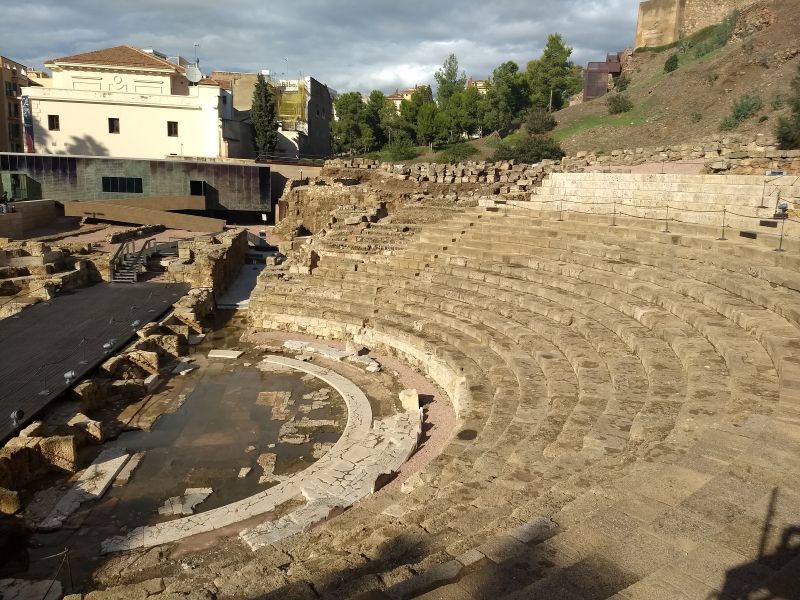
This was the first time I had ever stood inside an ancient Roman structure, and the feeling of stepping into that space completely hit me. For someone like me who isn’t super imaginative, reading about history in a book only goes so far. Seeing the physical ruins bridges that gap in a way nothing else can. You can’t help but stop and think about what actually happened on these stones during ancient times.
The theatre layout is incredibly well-preserved, from the semi-circular orchestra floor at the bottom — which was essentially the VIP section of the ancient world — to the grand tiers of spectator seating built right into the side of the hill. I haven’t made it to Italy yet (though I know there’s a massive, world-famous Colosseum waiting for me over there), but standing here, your mind immediately goes to the movies. Everyone has seen Gladiator, right? It is wild to think about a crowd filling these exact stone benches over two thousand years ago.
Quick Stats: Teatro Romano de Málaga
- Built: 1st century BC, during the reign of Emperor Augustus
- In use until: 3rd century AD — that’s roughly 300+ years of performances
- Size: Approximately 16 metres high and 31 metres in diameter
- Seating capacity (today): 220 spectators — yes, it still hosts live performances in summer
- Rediscovered: 1951
- Admission: FREE
Buried, Forgotten, and Accidentally Found
The absolute coolest part about the Teatro Romano is its backstory. Built in the 1st century BC under Emperor Augustus, it was used for centuries before eventually being abandoned. Over time, it was repurposed — used as a cemetery in the 5th and 6th centuries — and then the stones were gradually recycled by the Moors to help build the Alcazaba fortress above it.
Then? It essentially disappeared. Buried under layers of sediment and later structures, it sat completely forgotten until 1951, when workers digging up the area to landscape a garden accidentally hit ancient stone. What they uncovered turned out to be one of the best-preserved Roman theatres in Spain.
After restoration work that stretched over decades, the theatre officially reopened as a scenic space in September 2011 — and it held its first stage performances in millennia that very night. The oldest monument in Málaga, back in the spotlight. I think that’s pretty remarkable.
Fun fact: The theatre is actually a bit of an architectural oddity. Rather than the typical Roman approach of building on flat ground with an artificial structure, it was built into the natural hillside — a technique more commonly associated with ancient Greek theatres. It’s a subtle but fascinating cultural crossover.
Don’t Miss: The Glass Pyramid in the Plaza
Right near the theatre entrance, keep an eye out for the modern glass structures built flush into the ground of the plaza. Peer down through the glass and it acts as a window into a subterranean archaeological dig site — the remnants of an ancient Roman fish-salting factory. The Romans were processing garum (a fermented fish sauce that was essentially the ketchup of the ancient world) right here. It is the ultimate reminder that history is literally buried beneath your feet everywhere you walk in this city.
From the Theatre to the Fortress: Heading Uphill
Once you’ve had your fill of the teatro, don’t walk away — look up. The Alcazaba looms directly above you on the same hill, close enough that you can begin climbing to it almost immediately. That’s the beauty of doing these two sites together: there’s no transportation, no long walk, no planning required. You simply start heading uphill, and within minutes you’ve crossed from ancient Rome into the medieval Moorish world. It genuinely feels like time travel.
Climbing Into the Alcazaba
Looming massively on the hillside directly above the Roman theatre is the Alcazaba of Málaga — one of the finest surviving Moorish palatial fortresses in Spain.
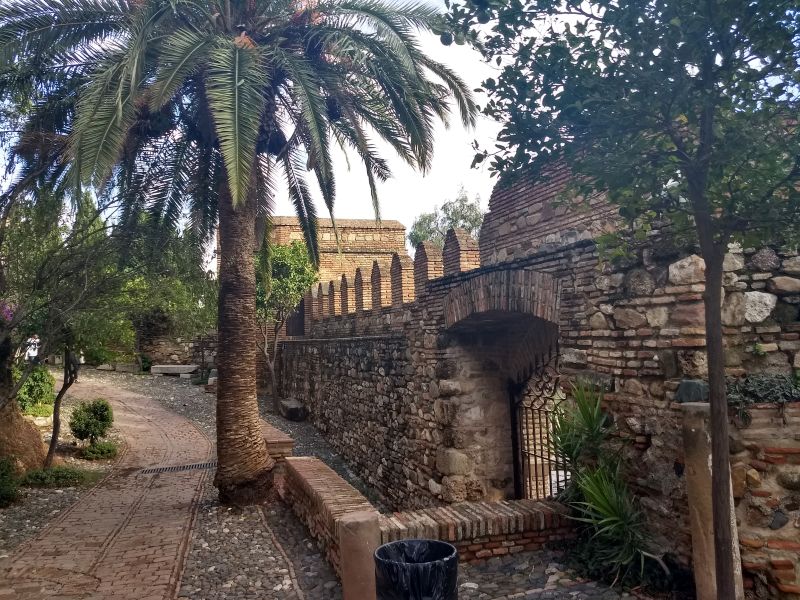
Specifically, it is an 11th-century fortification built between 1057 and 1063, under the orders of Badis ben Habus, the Berber king of the Taifa of Granada. The word alcazaba comes from the Arabic word for citadel or fortress — and it was designed to serve a dual purpose: a formidable military stronghold to protect the city from invaders, and a beautiful walled palace for the local governors.
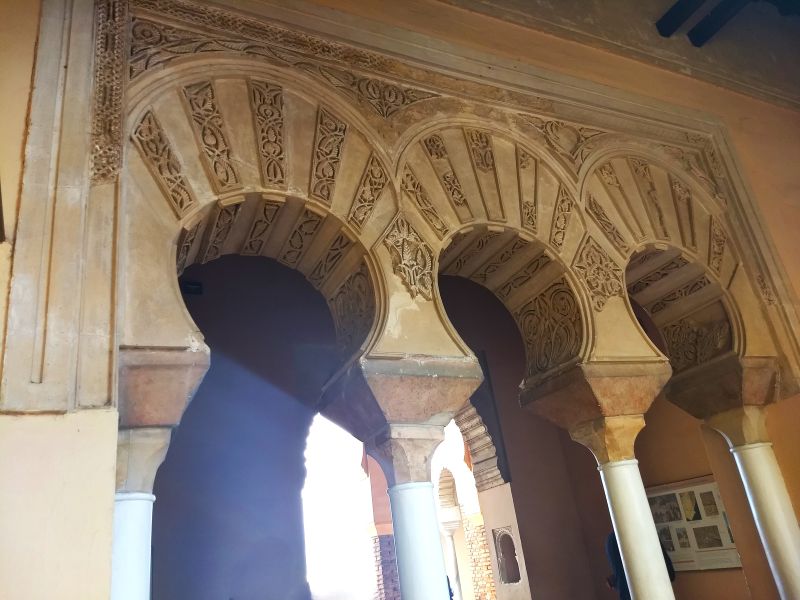
Once you get past the heavy defensive outer walls, the interior transitions into something entirely unexpected. It feels less like a stark military base and more like a royal estate, complete with brick walkways, lush palm trees, blooming gardens, and ornate carved archways. The contrast between the imposing exterior and the peaceful inner courtyards is genuinely one of the most memorable architectural experiences I’ve had.
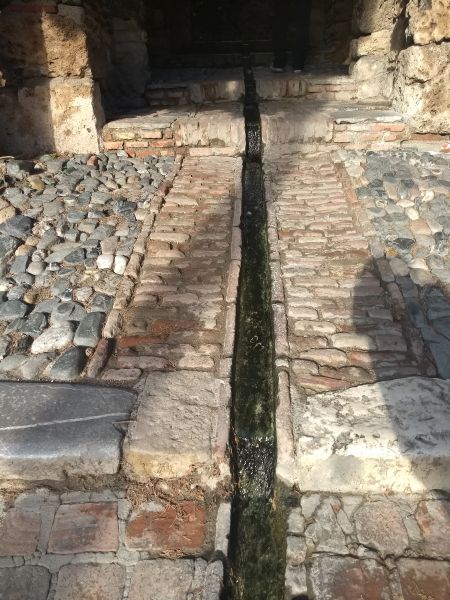
What I appreciated the most was the intricate details to their doorways and windows. And the first time I saw an ancient water system – the Moors also engineered narrow water channels running down the center of the stone walkways to keep the air cool and the gardens watered — a classic feature of Islamic palace design. Hundreds of years later, they still trickle water today.
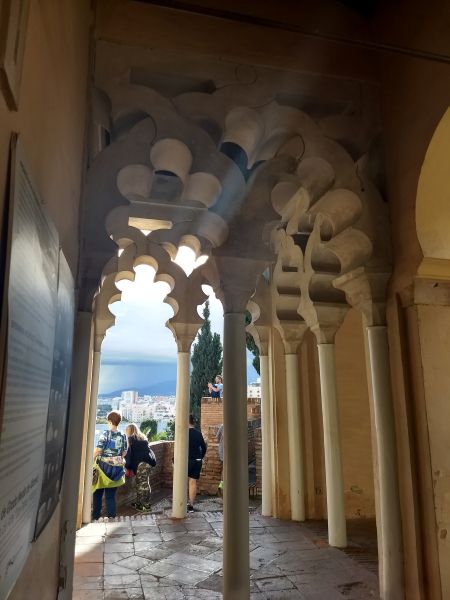
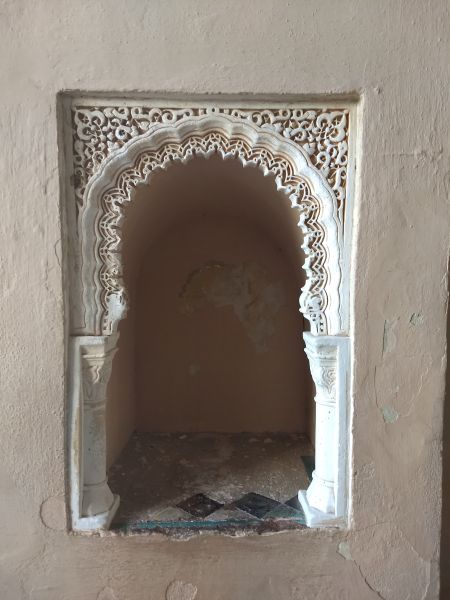
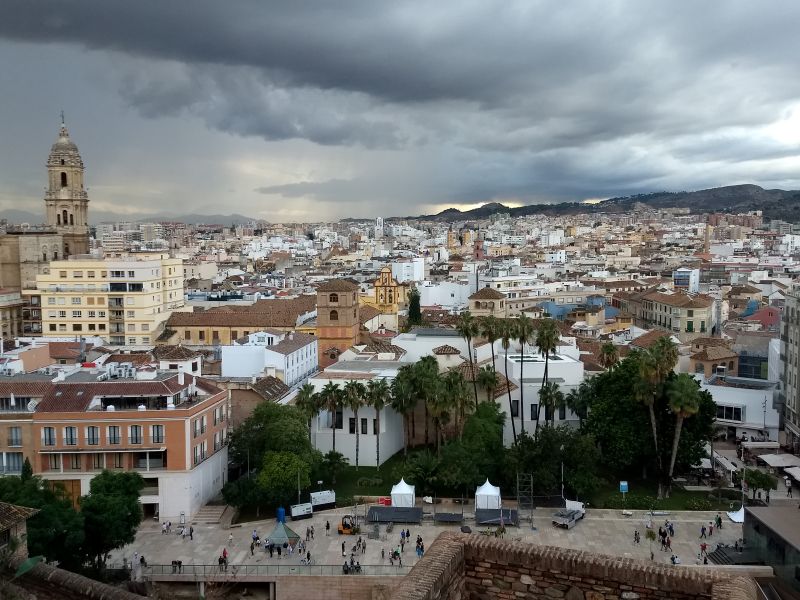
Walking through this place is nothing short of remarkable. Because it sits high up on the hill, as you climb through the complex, the panoramic views of Málaga’s rooftops, the cathedral tower, and the glittering Mediterranean open up around you at every turn.
Quick Stats: Alcazaba de Málaga
- Built: 1057–1063 AD
- Style: Moorish (Taifa and Nasrid periods)
- Size: Approximately 15,000 square metres (historians believe the original was more than double this)
- Towers: Over 100 towers remain within the complex
- Admission: Small fee (very worth it)
- Worth noting: The Alcazaba actually predates both the Alhambra in Granada and the Alcázar in Seville by roughly three centuries — making it one of the earliest surviving examples of this architectural style in Spain
Fun Fact: The Alcazaba and the nearby Gibralfaro Castle (visible on the hill above) are connected by a hidden underground tunnel that was used as a communication and supply route during sieges. You’re walking over a secret medieval tunnel. Think about that for a second.
Bringing History to Life
Ultimately, standing at the crossroads of the Teatro Romano and the Alcazaba proves exactly why traveling to these historic sites is so essential.
There is a massive difference between reading about something in a history book and actually standing on a physical stone step that someone carefully carved out over two thousand years ago. Seeing the sheer scale of these ruins with your own eyes bridges that gap in a way that imagination alone just can’t match.
What makes this hillside truly unlike anywhere else is the way each layer tells the next layer’s story. The Romans built a theatre. The Moors liked the location so much they built a fortress right above it — and when they needed building materials, they didn’t look far. Walk through the Alcazaba’s brick and stone entry gateways and look closely at the pillars supporting those horseshoe arches: those are Roman columns, lifted straight from the theatre below. Then in 1951, construction workers stumbled over the buried remains of all of it. Now you can stand in the middle of a vibrant modern city and take in 2,000 years of history in a single afternoon, for next to nothing.
Málaga is an incredible reminder that history isn’t just a story told in classrooms — sometimes, it’s a living, breathing landmark waiting for you right in the middle of town. The Teatro Romano and Alcazaba in Málaga were certainly highlights from our visit.
Check out the other posts related to this trip:
- 12 day Itinerary: Barcelona, Málaga & Madrid — Fun Days of Tapas, History & Cava
- Day Trip From Barcelona: Montserrat and Oller del Mas Tour Guide
- Visiting the Teatro Romano and Alcazaba in Málaga: Two Thousand Years in One Afternoon
- Taming the Tapas: Cooking Classes, Late Nights, and the Ham That Changed My Mind
- Ruined by Rain: Our Soaked, Short-Lived Day Trip to Ronda
- Day Trip to the Rock of Gibraltar from Málaga
- Is it Gaudi or Gaudy? A 2018 Tour of Barcelona’s Wildest Masterpieces