
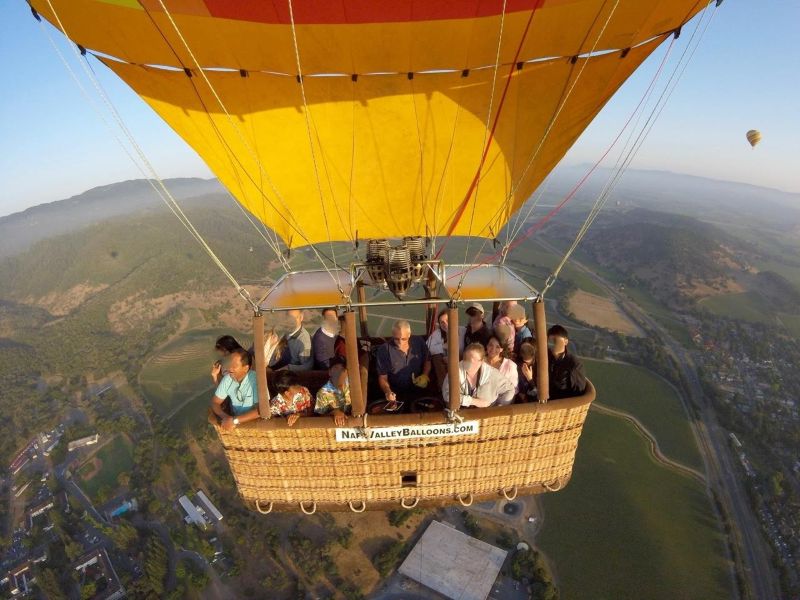
There’s something magical about watching hot air balloons rise into the predawn sky. I’d witnessed it before at balloon festivals in Albuquerque and Colorado Springs, standing among crowds as dozens of colorful balloons inflated in the darkness, flames roaring to life, casting an otherworldly glow across the launch field. The collective gasp of spectators as balloon after balloon lifted off, silhouetted against the awakening sky—it’s a feeling I can barely put into words. Something big. Something that makes you feel wonderfully small and impossibly alive all at once.
But I’d never actually been in one of those baskets. Until May 2016.
Skip to-
The Perfect Adventure
My girlfriend and I were spending a long weekend in California, a trip that would eventually take us to Yosemite National Park. But first, we found ourselves in Napa Valley, surrounded by vineyards and rolling hills that seemed purpose-built for aerial viewing. When one of us suggested a hot air balloon ride—I can’t even remember who brought it up first—it felt like the universe aligning. Neither of us had done it before. Justin wouldn’t have been interested (he’s more of a feet-firmly-on-the-ground kind of person), which made it the perfect girls’ adventure. We booked it immediately.
The alarm went off brutally early; we had to be at the NapaValleyBalloon location before sunrise. We stumbled out of our accommodations in the predawn darkness, that particular kind of tired-excited that only happens when you’re doing something completely out of the ordinary. The air was cool and still—perfect ballooning weather, as we’d soon learn.
Meeting Our Pilot
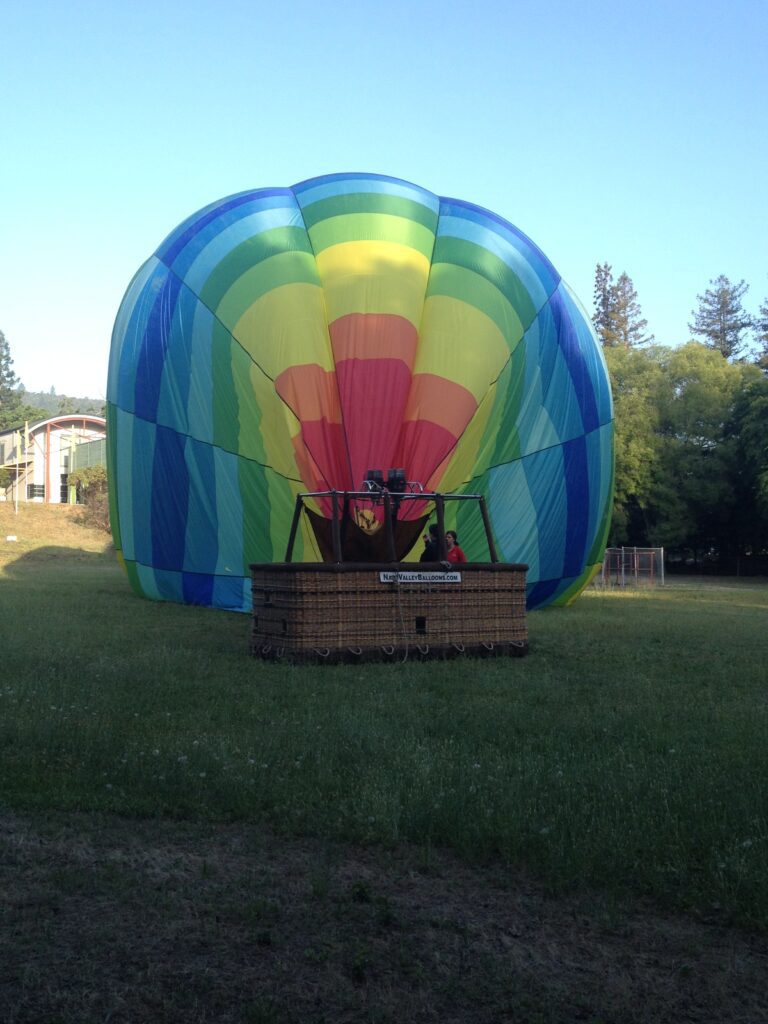
At the launch site, we met our pilot, a man with the calm confidence of someone who’d done this particular dance with physics and atmosphere a thousand times before. He walked us through the safety briefing with practiced efficiency, then assigned us our positions in the basket.
And here’s what surprised me: the basket was tight. Really tight. It wasn’t one open container but several compartments divided by leather-wrapped supports, each section holding just a few passengers. We squeezed into our designated spots, shoulders touching strangers who would become our temporary companions in this aerial adventure. There’s an intimacy to ballooning that I hadn’t anticipated—you’re quite literally in this together, sharing this small wicker rectangle suspended beneath a massive envelope of heated air.
A Brief History of Taking Flight
Hot air balloons have a surprisingly long history. The first untethered manned flight took place on November 21, 1783, when Jean-François Pilâtre de Rozier and François Laurent d’Arlandes floated over Paris for about 25 minutes, traveling roughly five and a half miles. The balloon was designed by the Montgolfier brothers, Joseph-Michel and Jacques-Étienne, who had been experimenting with lifting lighter-than-air objects using heated air. Their first public demonstration earlier that year had featured a sheep, a duck, and a rooster as passengers—thankfully, all three survived the eight-minute flight.
The science is elegantly simple: heated air is less dense than cool air, so it rises. Modern balloons use propane burners to heat the air inside the envelope (that’s the official term for the balloon part), and the pilot controls altitude by adjusting the heat. Want to go up? Fire the burner. Want to descend? Let the air cool. There’s no steering, though—you go where the wind takes you, which is part of the magic and the challenge.
Liftoff
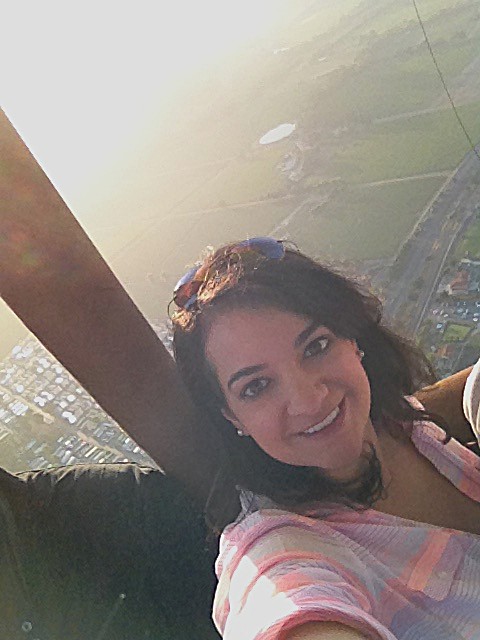
Then it was time. Our pilot fired the burner—a roar of flame and heat that you feel in your chest—and slowly, almost imperceptibly at first, we began to rise. The ground fell away in inches, then feet, the horizon expanding with each passing moment. There’s no sensation of movement, really. No engine vibration, no forward thrust. Just this serene, impossible floating. The world simply gets smaller and quieter beneath you.
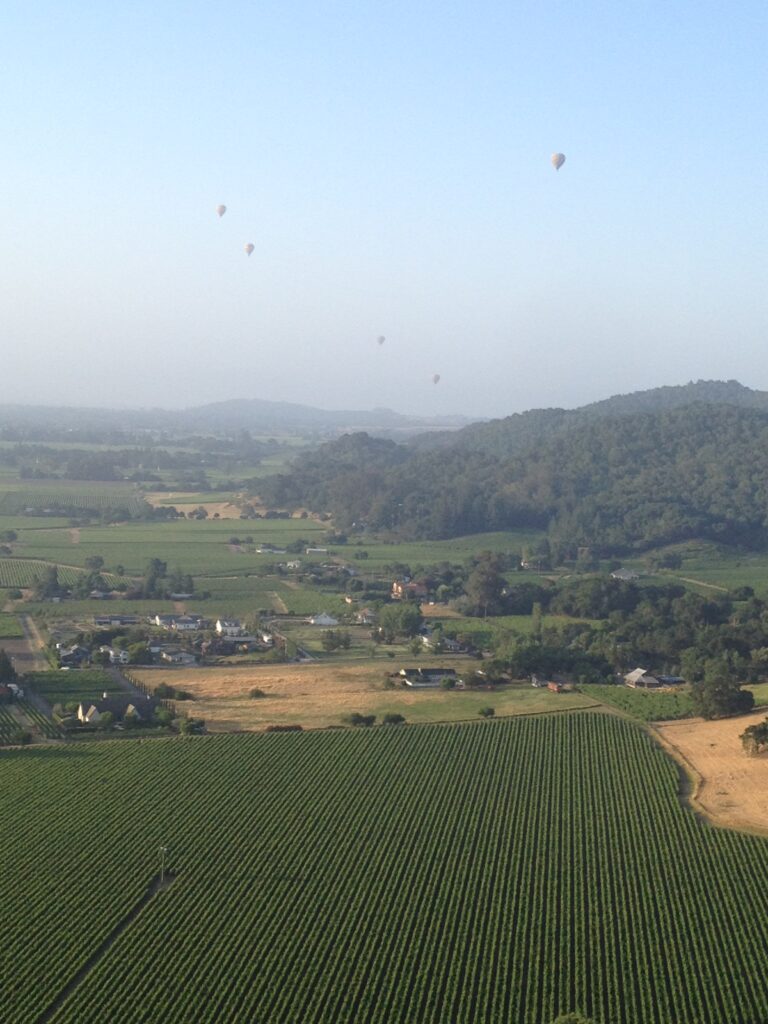
The Sonoma Valley spread out below us in the golden light of early morning: neat rows of grapevines creating geometric patterns across the hillsides, the occasional farmhouse or winery building looking like something from a model train set. The air was remarkably still, which meant we weren’t traveling much laterally—mostly just rising and rotating slowly, giving us a 360-degree panorama as we turned.
This was the only mildly disappointing aspect of the flight. I’d imagined gliding across the landscape, covering miles of territory, having that sense of journey. Instead, we mostly hovered and rotated, a vertical elevator more than a vehicle of exploration. But even this had its own beauty. We weren’t rushing past anything. We had time to really see, to absorb, to appreciate the view from every angle.
An Unexpected Role
About midway through our flight, something unexpected happened. The man in my section of the basket held up his phone toward me. It was recording. Before I could fully process what was happening, he’d passed it to me and dropped to one knee—well, as much as one can in a cramped wicker basket floating a thousand feet in the air.
He was proposing.
His girlfriend gasped, cried, said yes. It was beautiful and touching and completely spontaneous from my perspective. And suddenly I was the photographer, holding this stranger’s phone steady, making sure I captured this moment that they’d remember forever.
I’ll admit, part of me felt a flash of annoyance. I’d paid for this experience too. I wanted to be present in it, to soak in every moment, not to spend it documenting someone else’s milestone. But the feeling passed quickly. How could I be anything but happy for them? How many people get engaged in a hot air balloon at sunrise above wine country? I was witnessing something extraordinary, even if it wasn’t my extraordinary thing. Sometimes you’re the protagonist of your own adventure, and sometimes you’re a supporting character in someone else’s story. Both have value.
Coming Back to Earth
All too soon, our pilot was preparing us for landing. I’d wondered what this would be like—would we bounce? Tip over? I’d heard stories of dramatic balloon landings requiring passengers to brace themselves. But ours was smooth as silk. We descended gradually, the pilot expertly managing the heat and finding a gentle landing spot in an open field. The basket touched down with barely a bump, and just like that, we were earthbound again.
The ground crew arrived moments later (they’d been following us in a chase vehicle), and helped pack up the balloon—a surprisingly physical process that made me appreciate just how much fabric and equipment goes into these flights. There was champagne, as is tradition. Apparently, early French balloonists carried champagne to appease farmers whose fields they landed in, and the custom stuck.
The Verdict
Would I do it again? Absolutely. Despite the early wake-up, the cramped quarters, the unexpected photography duties, and the relatively stationary flight, it was an incredible experience. There’s something profound about floating silently above the earth, held aloft by nothing but heated air and centuries-old principles of physics. It’s peaceful and thrilling simultaneously, familiar and utterly foreign.
The next day, we drove to Yosemite, where we’d marvel at different kinds of heights and vastness. But that morning above Sonoma Valley remains one of my favorite travel memories—proof that sometimes the best adventures are the ones you’ve watched others experience for years before finally taking the leap yourself. Or, in this case, the float.
Click here to read about my other bucket list adventures.