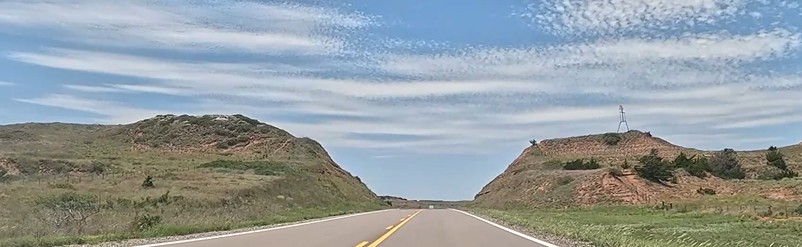
If your mental image of Kansas is entirely flat, golden wheat fields, the Gypsum Hills Scenic Byway will completely shatter that stereotype. Spanning 42 miles along U.S. Highway 160 between Medicine Lodge and Coldwater, this route drops you into an otherworldly landscape of vibrant crimson soil, deep canyons, and ancient, flat-topped mesas.
We recently took advantage of an open afternoon on our western Kansas road trip to cruise this designated scenic byway. Here is our completely honest takeaway on what to expect, the fascinating science behind the scenery, and whether you should add it to your itinerary.
Jump to:
The Geology: Why is the Ground So Red?
The dramatic topography of the “Gyp Hills” (also known as the Red Hills) dates back roughly 250 million years to the Permian Period, when a vast, shallow inland sea covered this region. As the sea repeatedly flooded and evaporated, it left behind thick layers of mineral deposits known as evaporites—specifically salt and white gypsum.
Over millennia, water carved away the softer surrounding rock, leaving a rugged terrain of steep buttes and canyons. Two distinct geological features define this drive:
- The Iron Oxide (Rust): The brilliant brick-red color of the shales, siltstones, and sandstones comes from iron oxide. When these ancient iron-bearing sediments are exposed to oxygen, they rust, creating the deep crimson hues that line the highway ditches and hillsides.
- The Gypsum Caps: Look closely at the tops of the mesas and you’ll notice a lighter layer of rock. This is massive rock gypsum. Because it is more resistant to weathering than the underlying red shales, it acts as a protective “cap,” preserving the flat-topped shapes of the hills.
The Reality of Driving the Byway
Kansas designated this stretch as a scenic byway to showcase this highly unusual, Southwest-style physiographic region. Visually, it delivers. The contrast of bright red earth against green cedar-capped hills under a massive prairie sky is undeniably beautiful.
However, from a road-tripper’s perspective, you need to know what you are getting into:
- Zero Infrastructure: There is virtually nothing to do off the main road. Unlike many national or state scenic byways, this route features almost no formal scenic pullouts, historical markers, or places to safely park and stretch your legs.
- Private Land Boundaries: The sweeping views on either side of U.S. 160 belong almost entirely to private working ranches. You are strictly there to enjoy the view from your windshield; there are no trailheads or public access points along the highway itself.
- Peaceful, Low-Traffic Cruising: On the plus side, there was almost no traffic when we drove it. If you enjoy a quiet, solitary drive where you can just cruise at your own pace without a line of cars on your bumper, you will find this stretch incredibly peaceful.
The Verdict: Is It Worth It?
Our rule of thumb for the Gypsum Hills Scenic Byway is simple: Don’t make a dedicated day trip just for this drive, but absolutely take it if it’s already on your path.
Because you cannot get out of the car to explore, a standalone trip might leave you feeling a bit underwhelmed. But if you are already transiting through southern or western Kansas, bypassing the interstate to cut across U.S. 160 is a no-brainer. It adds spectacular visual variety to your journey and perfectly embodies what Footprints and Freeways is all about—discovering the dramatic landscapes hidden along the backroads.
Gypsum Hills Scenic Byway Drive Video
Check out our drive of the red hills in the video below! We drove it East to West (Medicine Lodge to Coldwater).
Other Posts from this trip: