
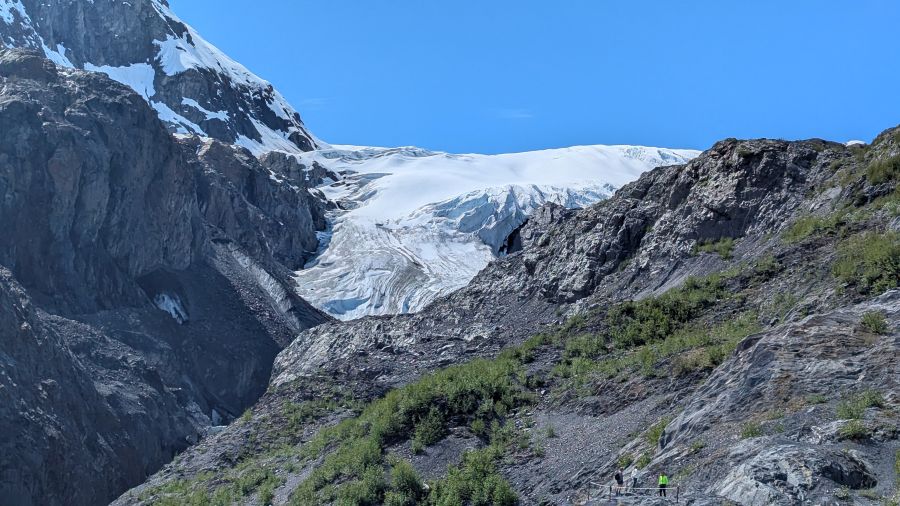
Seward, Alaska, is a charming coastal town nestled between the mountains and Resurrection Bay, serving as a gateway to some of the state’s most spectacular natural wonders. Among them, Exit Glacier in Kenai Fjords National Park stands out as an incredibly accessible and awe-inspiring example of a glacier in flux. Having seen (and walked on) my first glacier just a few days prior, it was now Justin’s turn to experience his first glacier—and what an introduction it would be.
In this post:
Getting There
Exit Glacier is unique because it’s one of the few glaciers in Alaska that you can easily access on foot, without requiring a boat tour or small plane. The drive from downtown Seward to the Exit Glacier Nature Center is both scenic and manageable, taking about 25 minutes along a well-maintained road that winds through dense forest. Along the way, we caught glimpses of the Resurrection River and watched the landscape gradually shift from coastal vegetation to the rugged terrain surrounding the glacier valley.
Upon arrival, the Nature Center provides helpful information about the glacier’s history and the park’s ecology. From there, visitors have two main trail options: the challenging Harding Icefield Trail, an 8.2-mile round trip strenuous hike that climbs over 3,000 feet to reveal panoramic views of the massive icefield that feeds Exit Glacier, or the more accessible Exit Glacier Trail. We weren’t prepared for a full-day alpine adventure, so we opted for the latter.
The Trail Experience

The Exit Glacier Trail features two loops, which gave us the flexibility to create our own route and see different perspectives of the glacier. We chose to take the slightly longer route on our way in, first stopping at Glacier View, where we were treated to a sweeping vista of the Outwash Plain—a broad, rocky expanse carved and shaped by glacial meltwater over millennia. The braided streams cutting through the gray sediment created an almost otherworldly landscape, a testament to the glacier’s powerful erosive force.
From there, we continued along the trail to the Glacier Overlook, then looped back via a different path. The first section of trail is paved and quite easy, accommodating visitors of all fitness levels, including families with strollers and those with mobility considerations. The second portion transitions to a natural, unpaved trail with some uneven ground and modest elevation gain—nothing too strenuous, but enough to make you feel like you’ve earned those glacier views.
A Landscape in Transition
As we began our walk, the landscape gradually transformed around us. What started as lush Alaskan forest—thick with Sitka spruce, cottonwood, and alder—slowly gave way to a more rugged, almost barren environment. The trees became sparser and more stunted, eventually disappearing entirely as we entered the rocky moraine zone.
One of the most striking features of the trail is the series of dated markers placed along the path, each indicating where the glacier’s terminus stood in different years. These signs create a stark and sobering visual timeline of climate change, showing the glacier’s dramatic retreat over the past century and a half. Seeing markers from the 1800s nearly a mile away from the current ice edge was a powerful, visceral reminder of how quickly these immense ice formations can recede. It transformed our hike into something more than just a nature walk—it became a journey through time and a meditation on our changing planet.
At the Glacier’s Edge
The air grew noticeably cooler and the wind picked up as we approached the glacier viewing area, carrying with it the faint scent of fresh ice and ancient minerals. Despite the remote feeling of the location, there weren’t many people on the trail itself with us—perhaps a dozen hikers spread out along the route. However, both viewing platforms were busier, with visitors gathered to take in the spectacle.
Standing at the overlook, we were confronted with Exit Glacier’s massive blue-white face, crevassed and imposing against the mountain backdrop. The ice appeared to glow with an ethereal quality, ranging from brilliant white at its surface to deep cerulean blue in its shadowed cracks and crevices. We could hear the occasional crack and rumble—the glacier’s voice—as it continued its slow but constant movement down the valley.

Like everyone else, we initially pulled out our cameras and took photos, trying to capture the scale and beauty of what we were witnessing. But after a few minutes, we consciously put our devices away to simply be present in the moment. We stood in silence, appreciating where we were, feeling the cold wind off the ice, and trying to imagine what this valley must have looked like decades ago when the glacier filled the space where we now stood. Those dated trail markers suddenly felt more meaningful—we were literally standing in what had once been hundreds of feet of solid ice.
What We’d Do Differently
The park offers ranger-led guided tours once daily during the summer season, and I would have genuinely loved to participate in one. Whenever possible, we try to join ranger-led talks and walks because they invariably enrich our experience with geological insights, historical context, and ecological details we’d otherwise miss. The rangers at Kenai Fjords are known for their passion and expertise, and I imagine hearing their interpretation of the glacier’s story would have added another dimension to our visit.
If we had another day in Seward—or when we return, which feels inevitable—I would love to explore Exit Glacier from other perspectives. Kayaking in the glacier-fed waters of this area would offer an entirely different vantage point, paddling through icy waters where icebergs occasionally float. Alternatively, a boat tour of the fjords would allow us to see multiple glaciers calving into the sea, getting remarkably close to these frozen giants. I’ve heard from other travelers that witnessing a glacier from the water, with chunks of ice thundering into the ocean, is an unforgettable experience. The sheer scale becomes even more apparent when you’re bobbing in a boat at sea level, craning your neck to see the towering ice walls above.
Final Thoughts
Exit Glacier offers something rare: an intimate encounter with one of nature’s most powerful forces, accessible to almost anyone willing to take a short walk. It’s both beautiful and humbling, inspiring and sobering. The experience stays with you—not just the visual memory of that blue ice against gray rock and green forest, but the deeper awareness of our planet’s dynamism and fragility. For Justin’s first glacier experience, it couldn’t have been more perfect. For me, having now seen glaciers from multiple perspectives, Exit Glacier reinforced why these frozen rivers continue to captivate us: they’re simultaneously ancient and ephemeral, permanent fixtures of the landscape that are nevertheless constantly changing, always moving, always melting, always reminding us that nothing—not even ice that’s thousands of years old—lasts forever.
View other posts from this trip:
Memorable 14 Day Alaska Itinerary (Anchorage, Seward, & Fairbanks)
Our 3hr Fat Tire Truck Adventure Near Denali
Crossing the Line: Our Arctic Circle Experience
Whittier, AK: Tunnel & Glacier Cruise
A Walk on Matanuska Glacier
My day tour at the Musk Ox and Reindeer Farms in Palmer, AK
E-biking the Tony Knowles Coastal Trail
My packing list for 2 weeks in Alaska in May