
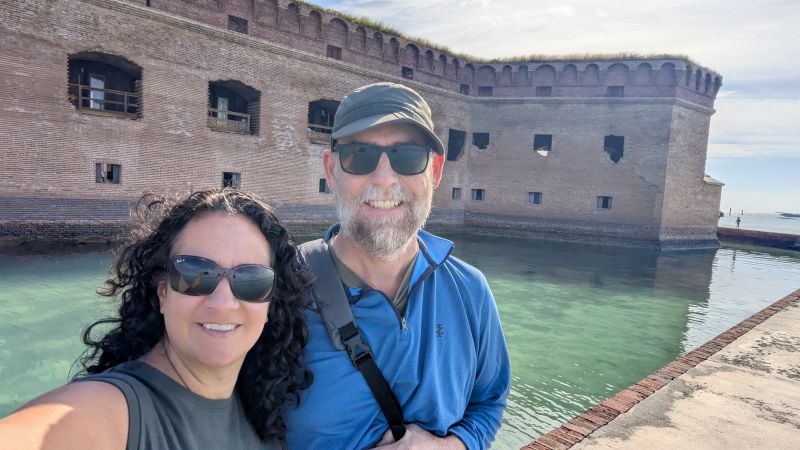
There is something truly inspiring about the diversity of our National Parks, Monuments, and Lands. From towering mountains to deep canyons, our country offers an incredible array of landscapes. Our recent trip to Key West gave us a chance to check one of the most remote and unique parks off the list: Dry Tortugas National Park.
Originally the name was Las Tortugas (the Turtles) given by the Spanish explorer Ponce de León who discovered the islands in 1513, for the abundance of sea turtles he found. The word “Dry” was added to navigation charts later to warn sailors that there was no fresh water naturally available on the islands. Dry Tortguas was first designated a National Monument by President Franklin D. Roosevelt in 1935, and later established as Dry Tortugas National Park in 1992—though 98% of the park’s 100 square miles is actually underwater!
Getting there is a feat in itself—it’s only accessible by boat or seaplane. We chose the former, booking a day tour on the Yankee Freedom III ferry. It was a long day (7:00 AM to 5:30 PM), but one we wouldn’t trade.
In this Article:
The Long Voyage Out
The boat ride covers 70 miles of open water, clocking in at 2 to 2 1/2 hours each way. With up to 175 passengers, the crew handled the check-in and boarding process with remarkable efficiency. We were encouraged to download the Yankee Freedom / Dry Tortugas app beforehand, which was great for accessing the day’s schedule and an audio tour.
We secured a spot on the bottom deck, which houses the galley and four well-maintained bathrooms (a critical point since there are no restrooms on the island). The time passed slowly, as we hadn’t thought to bring anything for entertainment. Lesson learned: if you take the ferry, pack a book, cards, or a downloaded show!
A simple breakfast (bagels, oatmeal, cereal) and lunch were included. Being vegetarian, I also had to notify the crew before 9 AM about lunch and was offered a mediocre hummus sandwich with banana pepper, lettuce, and tomato, I was grateful for an option, two really— but I should have went with the PB&J alternative!
Stepping onto Garden Key
After the long commute, the sight of Fort Jefferson dominating the tiny island of Garden Key was absolutely stunning.
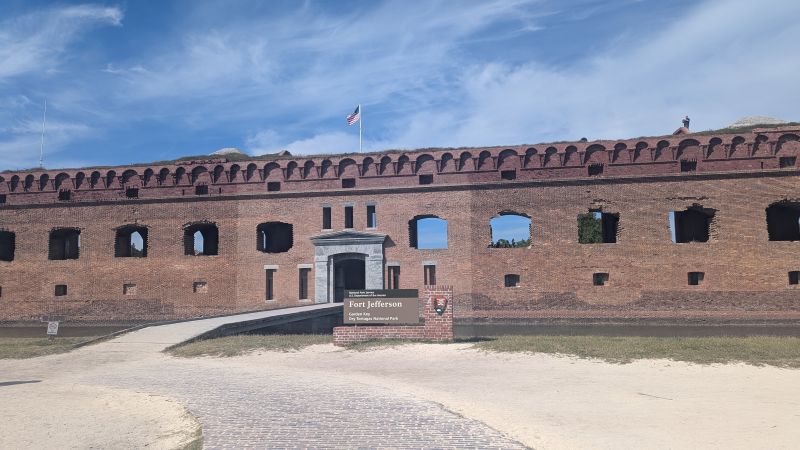
We had about 20 minutes of free time before the scheduled talk. We took the time to walk part of the moat barrier getting a good view of the fort from the outside. They were doing repairs on the wall, so we were unable to walk the full perimeter. This was my first, maybe second, fort that had a filled moat – and it was great to see that.
Hollywood, our guide (he was with us on the whole boat journey providing details and updates all day), was truly remarkable with his storytelling. We started with a 20-minute talk, followed by an optional one-hour tour; after all we were there to learn more about the fort so this was our big chance to learn about it without reading papers or listening to the audio tour.
While summer promises excellent, clear-water snorkeling, the winter offers perfect weather for touring the massive fort. A quick tip: Even in mid-December, when the weather was wonderfully pleasant (making it the ideal time to explore the fort), we were grateful to have bug wipes and spray! They were definitely out in the grass.
Fort Jefferson: The Guardian of the Gulf
The highlight of the day was undoubtedly the scale and completeness of the fort itself. Having visited several other historical forts, Fort Jefferson stood out immediately for its sheer size.
Your eyes aren’t deceiving you: this is the largest masonry structure in the Western Hemisphere, built from over 16 million bricks! Many of these earlier, lighter-colored bricks came from Pensacola, Florida before the Civil War, but later, darker red bricks were shipped from Maine leading to visible color changes in the massive structure and brick quality variation.
Though Fort Jefferson was never actually attacked, it successfully fulfilled its role as a powerful deterrent. Its presence and the warships that used its deep harbor protected one of the nation’s most critical shipping channels.
The History Behind the Bricks
- Strategic Design: Construction began in 1846. The fort’s purpose was to serve as the “Guardian of the Gulf,” protecting a critical deepwater anchorage along the busy shipping lane between the Atlantic Ocean and the Gulf of Mexico.
- A Failed Masterpiece: Despite nearly 30 years of construction, the fort was never officially completed. It began to crack and settle under its own massive weight, damaging the walls and the system designed to collect fresh rainwater.
- The Infamous Prisoner: During the Civil War, the Union used the isolated fortress as a military prison. Its most notable inmate was Dr. Samuel Mudd, who was imprisoned for aiding John Wilkes Booth after the assassination of President Lincoln. He was later pardoned after bravely assisting the fort’s personnel during a devastating Yellow Fever epidemic.
- Obsolescence: The introduction of the rifled cannon quickly made the fort’s massive walls vulnerable, leading to the Army’s final abandonment in 1874. It was eventually designated a National Monument in 1935.
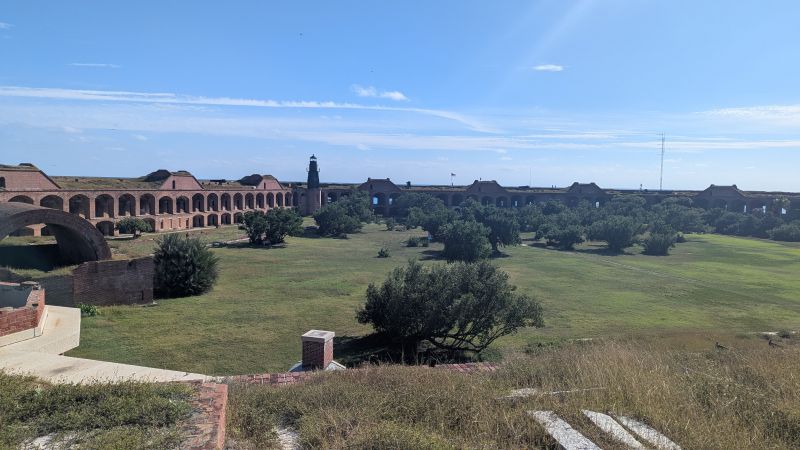
While there weren’t many cannons or artifacts on display, the sheer scale of the hexagonal structure—with over 2,000 arches in the casemates—is enough to convey its historical power.
The Journey Home (and a Race to Sunset)
Though we decided against snorkeling (the waters were too choppy to see much), we had a rare opportunity to walk on Bush Key that is usually closed for the birds nesting, which was a special treat!
The return trip was, to be honest, a very long ride, we just wanted to be back on Key West. (like reliving the Dalton Highway earlier this year but much shorter!)
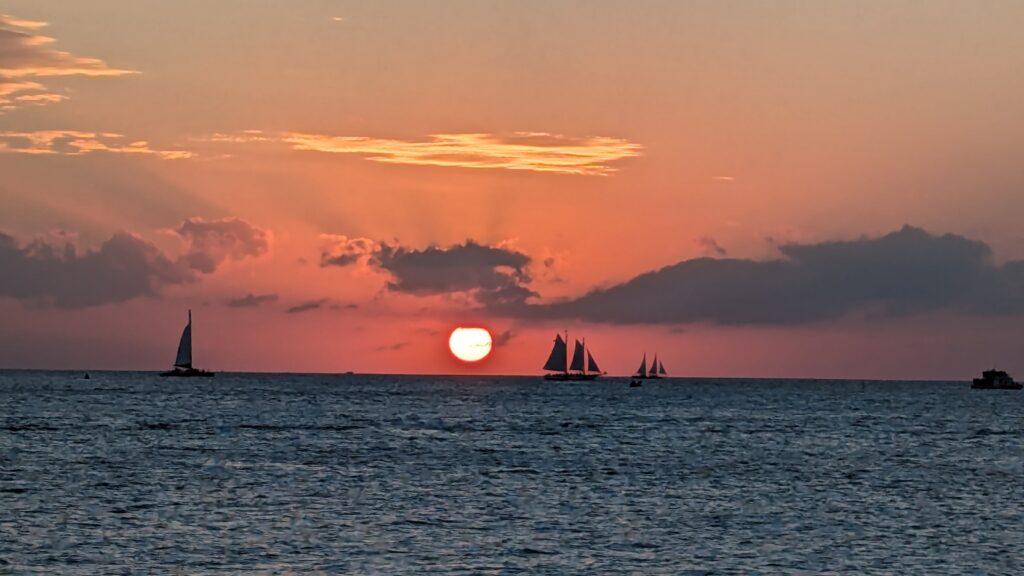
Our goal was to get to Mallory Square to catch the famous Sunset Celebration. With the sun due to set around 5:40 PM and rain forecast for the next night, this was our only shot. Thanks to riding our bikes to the dock and being one of the first ones off the boat, we made it to Mallory Square with three minutes to spare! We caught the final, beautiful moments of the sun dropping below the horizon. It was the perfect, dramatic ending to a long day.
Final Verdict: Boat vs. Plane
If I had to do it over, I would definitely look into getting to Dry Tortuga’s by plane, which would eliminate the four to five hours of commute time and would make the day feel much less exhausting. The cost of the seaplane looks to be about double (we booked our boat at $235 each) and for $494 you get 2 1/2 hours to explore – certainly enough time to visit the fort and possibly have a quick dip in the water. They also have full day — although not sure what I would do for 6 1/2 hours. But it would certainly be a splurge, for those that have those sorts of extra funds, it’s the way to go.
Some folks choose to spend the night camping there, I think there are 10 spots, I imagine it would be a wonderful place to see the dark night sky and you’d have time without so many daily visitors to explore on your own. I am not one for camping, but for those that like that, it could be a good opportunity.
In the winter, it would be a magical touch if the ferry timed the return to keep passengers on the boat during the actual sunset—everyone would get a spectacular view!