
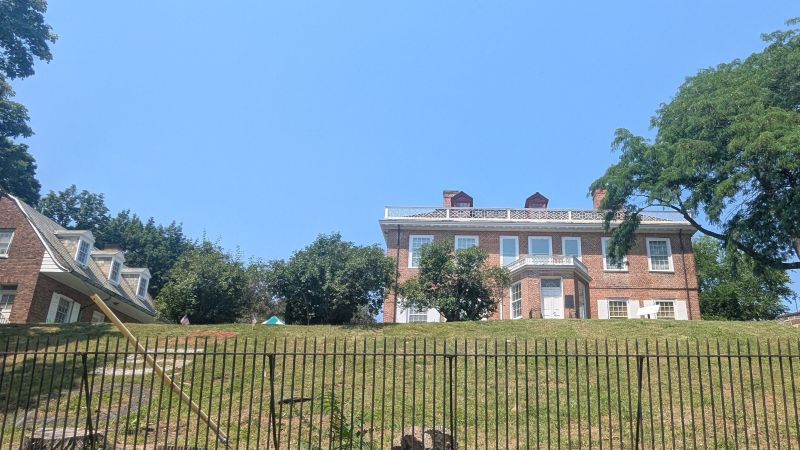
If you’d told me a decade ago that a Revolutionary War-era house museum would hold a 12-year-old’s attention for a full hour, I’m not sure I would’ve believed you. But that’s exactly what happened at the Schuyler Mansion State Historic Site in Albany, NY — and I’d put money on the reason having a first name and a last name: Hamilton.
This was one stop on our larger 3 Days Full of History & Fun in the Capital Region of NY trip, but it earned enough of our attention — and honestly, enough interesting history — that it felt worth its own post.
Why We Went
I found this one while researching the trip, but the second I saw it, I knew it was really my niece’s stop. She’s deep into the Revolutionary War right now, and like a huge number of kids her age, she fell hard for the musical Hamilton. Schuyler Mansion is where a good chunk of that story actually happened — not staged, not fictionalized, the real house.
The House and the Family
Schuyler Mansion was built between 1761 and 1765 for Philip Schuyler, a major general in the Continental Army who later served as a U.S. Senator, and his wife Catharine Van Rensselaer. Both came from prominent, wealthy Dutch families, and together they raised eight children in this Georgian-style home overlooking the Hudson River. The estate originally sat on about 80 acres, including an orchard, formal gardens, and a working farm.
The guest list over the years reads like a who’s-who of the founding era — Benjamin Franklin, George Washington, Benedict Arnold, and eventually Schuyler’s own son-in-law, Alexander Hamilton, all spent time here.
Before the Tour
We arrived a bit early and spent the wait browsing the exhibits in the visitor center. One standout: a large, tall video screen playing what felt like a series of interviews — people from different points in the house’s history sharing their stories. It was a smart, modern way to set the stage before walking into an 18th-century house, and it’s worth giving yourself a few extra minutes to actually watch it rather than rushing straight to the tour line.
Our group ended up small — just seven of us, including another family with two school-aged girls who, unsurprisingly, were also there because of Hamilton. Between the two families, it was clear this house has found a whole new audience thanks to a Broadway musical, and the site seems to know it — tours here are by reservation only, so it’s worth calling ahead rather than showing up and hoping for space.
Inside the House
The entry room is large and formal, covered in European landscape wallpaper.
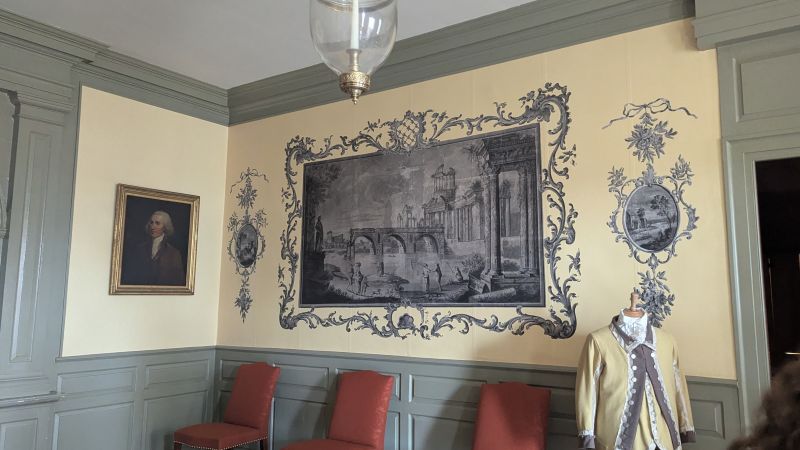
Just to the left is the family parlor — and this is the room where, on December 14, 1780, Elizabeth “Eliza” Schuyler, Philip’s second daughter, married Alexander Hamilton. It’s a small, sunlit room, and standing in it while the guide told the story of their courtship — a long-distance relationship carried almost entirely through letters while Hamilton served as one of Washington’s aides — was a genuinely nice moment. (Fun bonus fact for future visitors: this same parlor was also the site of another wedding decades later, when former President Millard Fillmore married his second wife there in 1858.)
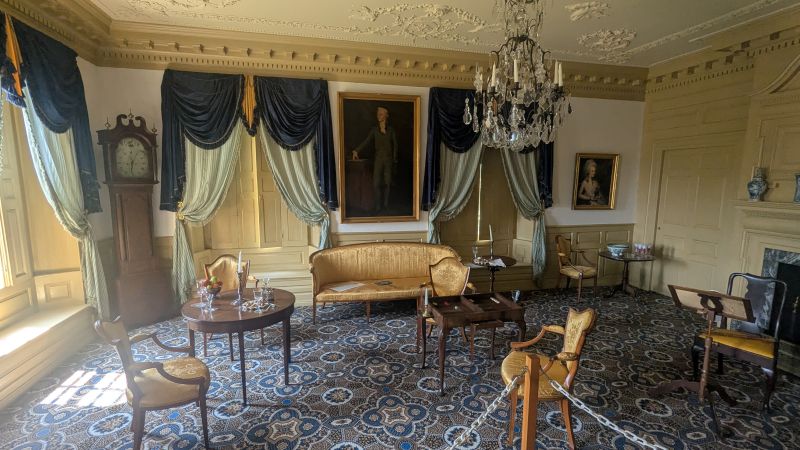
From there, we moved through room after room, at one point getting to touch a sample of the original flocked wallpaper — a fuzzy, printed texture that was apparently a real status symbol at the time.
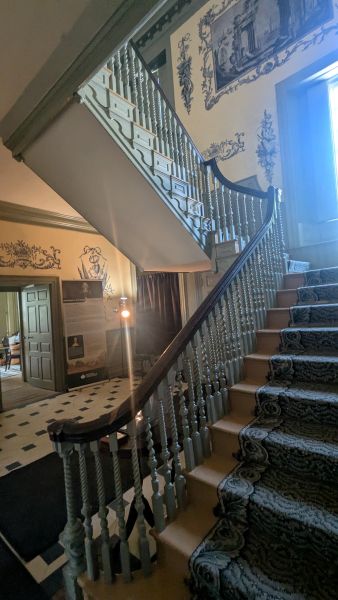
On the staircase, my niece noticed a visible groove worn into the banister and asked about it. She’d heard from a teacher that it came from a story about the lady of the house throwing a cleaver at an intruder during a break-in. Our guide was quick to gently correct that one — there was a real attempted attack on the house (a 1781 kidnapping raid targeting General Schuyler himself), but there’s no solid evidence for the cleaver detail specifically. It’s a great example of how house-museum folklore evolves; the guide handled it well, neither dismissing her question nor pretending the story was confirmed fact.
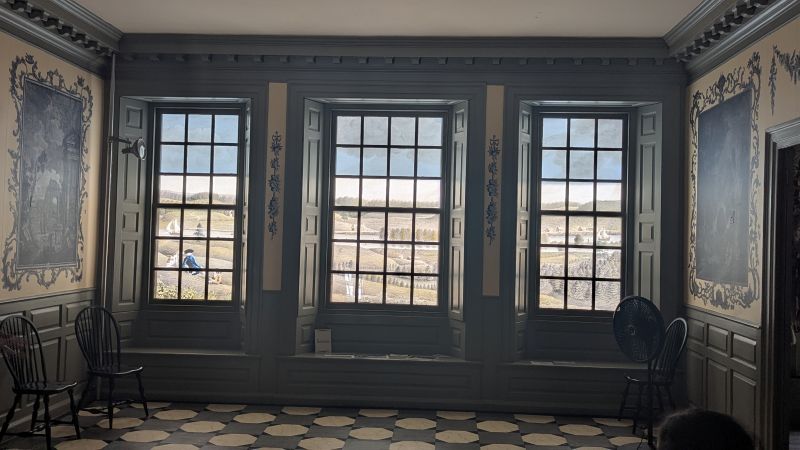
Upstairs, the hallway opens into a wide space that was used for parties and dancing, with four bedrooms branching off it. The windows were covered in a landscape from what the view would have looked like back in that time period.
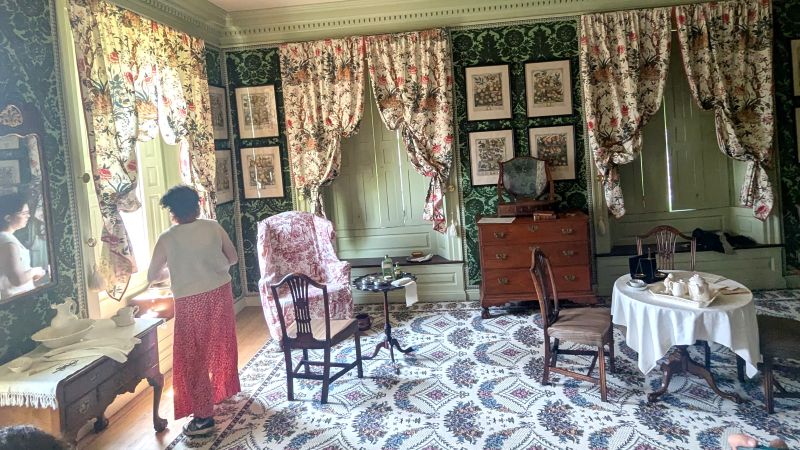
The most elaborately furnished belonged to British General John Burgoyne, who stayed here in October 1777 — not exactly a willing guest. After his surrender at the Battle of Saratoga, General Schuyler hosted his former enemy at the mansion with a surprising amount of hospitality, complete with a small guard posted outside to keep him safe. It’s a strange, almost gracious footnote to a war: the man whose troops had burned Schuyler’s other home to the ground weeks earlier, recovering from gout in one of Schuyler’s guest rooms.
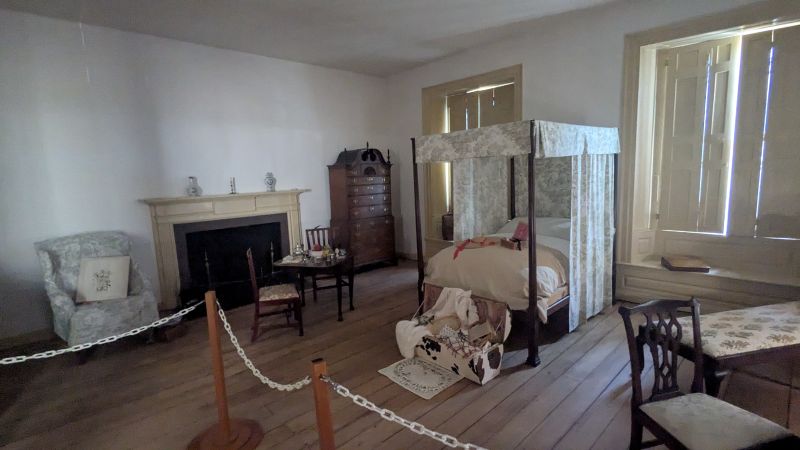
One more small detail that stuck with us: the beds throughout the house are noticeably shorter than a modern bed. The guide explained that people often slept semi-upright at the time, partly because of smoke from the fireplace lingering in the room overnight.
Off to one side of the upstairs area, a couple of laminated info sheets covered a later chapter of the house’s history — its time as an orphanage. It’s a small, easy-to-miss detail in the tour, but worth slowing down to read —
Between 1886 and 1914, the mansion was operated as an orphanage. It all started during a severe measles outbreak in Albany, which forced local Catholic orphanages to find additional space to isolate and care for sick children. Purchased by St. Vincent’s Orphanage and run by the Daughters of Charity, the grand estate was transformed into a sanctuary and care facility, eventually taking in children from St. Ann’s Orphanage in Troy and St. Margaret’s Home in Albany once the epidemic subsided.
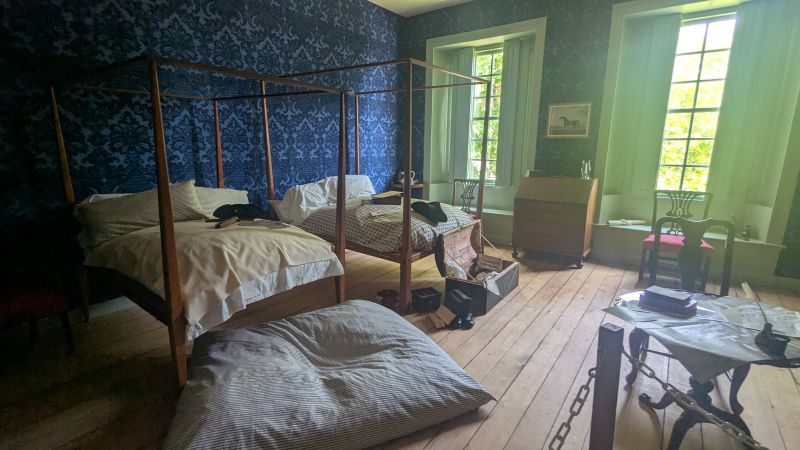
Seeing photos from that era really drives home how dramatically the mansion’s interior changed during this time. The grand upstairs hall—once used for elegant parties and dancing—was packed with rows of small beds, as was the Green Bedroom. As the need grew, a three-story addition was built onto the back of the mansion in 1895 to house dormitories and a new kitchen. By 1911, the property was no longer suitable for the orphanage’s needs, leading two Schuyler descendants, Louisa Lee and Georgina Schuyler, to help secure its sale to New York State. The orphanage relocated in 1914, paving the way for the building to be restored and opened as a historic museum in 1917.
The Verdict
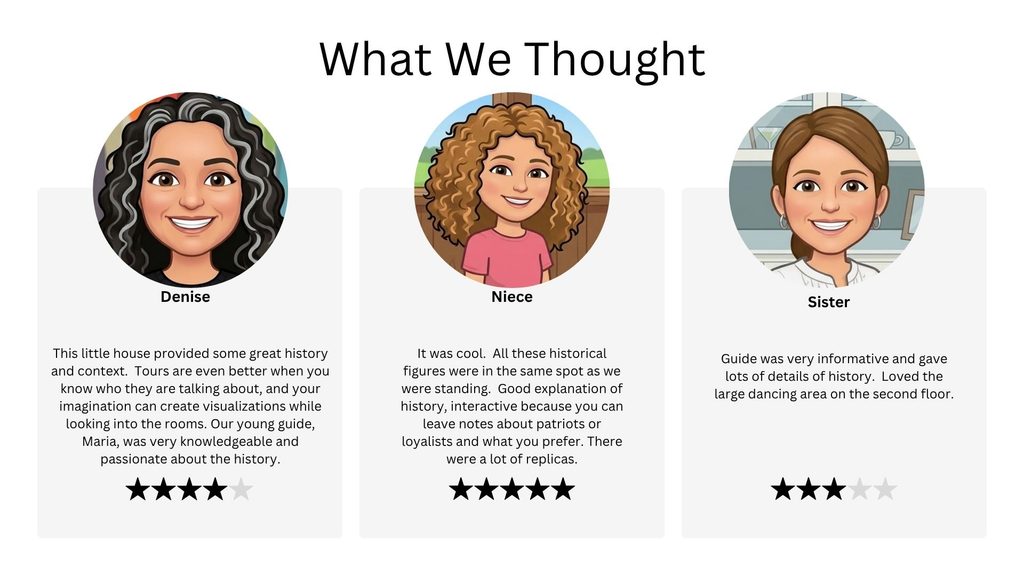
All three of us — two adults and one very Hamilton-pilled 12-year-old — left genuinely won over by this stop. It’s not a flashy site. There’s no gift shop rush, no big spectacle. It’s just a well-preserved house with a knowledgeable guide and a story that happens to intersect with one of the most famous musicals of the last decade. If you’ve got a kid (or an adult) in your life who can quote Hamilton lyrics, this is one of the more direct ways to connect that fandom to something real.
If You Go
- Address: 32 Catherine Street, Albany, NY 12202
- Phone: (518) 434-0834
- Season: Generally mid-May through October
- Tours: By advance reservation only — call ahead, since the site doesn’t guarantee walk-up availability. Tours typically run on the hour, starting at 11:00 a.m., with the last tour around 4:00 p.m., Wednesday through Sunday.
- Admission: In the ballpark of $5 for adults, less for seniors/students, and free for kids 12 and under — worth confirming current pricing when you call, since these can change.
- Good to know: You can only enter the mansion as part of a guided tour, so plan your visit around a tour time rather than a general open-house window.
More info: parks.ny.gov/visit/historic-sites/schuyler-mansion-state-historic-site
Other posts from this trip:
- How We Packed 3 Days Full of History & Fun in the Capital Region of NY
- Our Alpaca Hike at Clover Brooke Farm: A Walk That Might Talk You Into Buying Land
- Amsterdam Castle: Crossing “Sleep in a Castle” Off My Bucket List (Sort Of)
- Secret Caverns: The Cave with a Waterfall
- 90 Minutes at the Titanic Immersive Experience
- Adirondack Animal Land: Feeding an Emu Through a Car Window